The Spirit of Democracy

Think back to the time of 6th century BCE Athens. The city controlled an empire of dozens of separate Greek states. It was the world center of philosophy, science, and art. And it was the world’s first society to govern itself by democracy.

Of course we must qualify that statement by noting that only landed Athenian males 21 years of age and older were allowed to participate in the forms and offices of government. But within those limitations it was a true participatory democracy. Every eligible citizen was a member of the primary governing body– the Assembly. That would have been about 40,000 men at the height of the Empire. A quorum of the Assembly was 6,000 citizens.

We call it the age of Pericles, but he was neither king nor president. He was one of ten elected generals, each of whom served a one year term. He was elected to that position multiple times, so clearly he must have had both charisma and leadership skills. But it was the Assembly that made all key decisions. And all decisions were made by simple majority vote. In that respect the Athenian democracy was a true democracy, unlike our representative federation. Decisions of state in our system are not made by we the people, but by those we elect to represent us.

The delegates of what we now call the Federal Convention did not invent democracy, and they did not invent the key features of our federal system: separation of powers, a bicameral legislature, a hierarchical court system, and the guarantee of rights for all citizens. All of those elements were incorporated into the constitutions of various of the states after they declared independence.

The Constitution was a remarkable document for its time, but it retains many anti-democratic elements. The Senate represents states, not the people. Nine U.S. states contain more than half of total U.S. population, and yet those states only have 18% representation in the Senate. That is extremely unfair to the residents of the most populous states.

In 1929 Congress passed the Permanent Apportionment Act, which capped the total number of Representatives in the House at 435. That constraint, coupled with the Constitution’s requirement that every state must have at least one Representative, has resulted in the over-representation of low population states. The House now has 114 fewer members than it should on the basis of population alone.

Neither the House nor the Senate truly represent the national character. The Senate represents the separate states and the House represents state defined localities. The president is the only nationally elected official who represents the nation as a whole. That is the primary reason why the president and Congress are so often at odds.

And since the Electoral College is based on the number of members of the House and Senate, it amplifies the misrepresentations of those two bodies.

There is work to do if we wish our government to be more democratic and more fairly representative. But we should ask: is democracy necessarily a good thing? Can the public really be expected to make sound decisions in a world of every greater complexity? Perhaps we should allow those who have the greatest understanding of government, economics, and society to make the nation’s most important decisions. Maybe we would be wise to establish a class of professionals who are specially trained to lead the country, as imperial China did.

Alexander Hamilton touched on this question in his defense of the Electoral College:

It was equally desirable, that the immediate election should be made by men most capable of analyzing the qualities adapted to the station, and acting under circumstances favorable to deliberation, and to a judicious combination of all the reasons and inducements which were proper to govern their choice. A small number of persons, selected by their fellow-citizens from the general mass, will be most likely to possess the information and discernment requisite to such complicated investigations.

It was also peculiarly desirable to afford as little opportunity as possible to tumult and disorder. This evil was not least to be dreaded in the election of a magistrate, who was to have so important an agency in the administration of the government as the President of the United States. But the precautions which have been so happily concerted in the system under consideration, promise an effectual security against this mischief.

(The Federalist #68, Alexander Hamilton, 1788)

The chief question Hamilton did not answer in his musings is just how, exactly, we are to recognize the persons who possess the requisite “information and discernment”? We have seen many examples recently of people who loudly proclaim their credentials and their wisdom who in fact know little or nothing about their areas of alleged expertise.

Should we expect the average citizen to be an expert on all matters relevant to the health and safety of the nation? No, absolutely not. But that doesn’t mean that the average citizen has no stake in national or international affairs. On the contrary, national issues have national impacts. The entire nation will almost certainly be adversely affected by foolish national policies.

The greatest risk to the nation is when our leaders lose touch with the people. The examples of the Vietnam and Iraq wars show that it makes no sense to engage in foreign wars if you do not have the full support of the people.

The divine right of kings was firmly entrenched in ancient Egypt by no later than 3000 BCE. The king, later called “Pharaoh,” was declared to be the son of Ra– literally the son of God. And yet the trappings of divinity could never disguise the fact that kings of the centuries since have had frailties and foibles, or that we all are subject to the indignities of our mortality.

There is no single class of people who are most qualified to lead. That simple truth is the central glory of democracy. Great leaders do not always have the greatest pedigrees. Trust the people.

Is economics complicated? Yes, as is immigration policy, trade policy, cybersecurity, and many other aspects of modern society. But those who seek our votes should be able to state their positions on the issues of the day in such a way that the average citizen can understand them. Those who sneeringly assume that the average citizen is too uninformed to make sound decisions do not deserve our votes.

The central principle of democracy, whether representative or participatory, is fairness. The idea that every citizen should have the right to vote and to expect that vote to count forces everyone to respect others. Other governmental systems do not necessitate such behavior. In fact many– especially autocracies– thrive on intolerance. That is why the spirit of democracy is the highest and the most basic– something every religion should call its own. Without tolerance people can easily fall into vindictiveness and aggression. Without respect for others they can become aloof and indifferent to human suffering. Democracy is the only governing principle that is predicated on tolerance for all.
Jesus was NOT the Son of God

When Jesus was baptized by John the Baptist, God declared that Jesus was in fact his son:

And when Jesus was baptized, just as he came up from the water, suddenly the heavens were opened to him and he saw God’s Spirit descending like a dove and alighting on him. And a voice from heaven said, “This is my Son, the Beloved, with whom I am well pleased.”

(Matthew 3:16 – 17)*

The claim that Jesus is the Son of God is repeated throughout the New Testament, as the following passages illustrate:

Mary said to the angel, “How shall this be, since I am a virgin?” The angel said to her,

“The Holy Spirit will come upon you, and the power of the Most High will overshadow you; therefore the child to be born will be holy; he will be called Son of God.”

(Luke 1:34 – 35)

When he came to the other side, to the region of the Gadarenes, two men possessed by demons came out of the tombs and met him. They were so fierce that no one could pass that way. Suddenly they shouted, “What have you to do with us, Son Of God?  Have you come here to torment us before the time?”

(Matthew 8:28 – 29)

Peter answered him, “Lord, if it is you, command me come to you on the water.”  He said, “Come.”  So Peter got out of the boat, started walking on the water, and came toward Jesus. But when he noticed the strong wind, he became frightened, and, beginning to sink, he cried out, “Lord, save me!” Jesus immediately reached out his hand and caught him, saying to him, “You of little faith, why did you doubt?” When they got into the boat, the wind ceased.  And those in the boat worshiped him, saying, “Truly you are the Son of God.”

(Matthew 14:28 – 33)

He said to them, “But who do you say that I am?”  Simon Peter answered, “You are the Messiah, the Son of the living God.”

(Matthew 16:15 – 16)

Whenever the unclean spirits beheld him, they fell down before him and shouted, “You are the Son of God.”

(Mark 3:11)

When Jesus saw Nathanael coming toward him, he said of him, “Here is truly an Israelite in whom there is no deceit!”  Nathanael asked him, “Where do you get to know me?”  Jesus answered, “I saw you under the fig tree before Philip called you.”  Nathanael answered him, “Rabbi, you are the Son of God!  You are the King of Israel!”

(John 1:47 – 49)

Jesus said to her, “I am the resurrection and the life. Those who believe in me, even though they die, will live, and everyone who lives and believes in me shall never die.  Do you believe this?”  She said to him, “Yes, Lord, I believe that you are the Messiah, the Son of God, the one coming into the world.”

(John 11:25 – 27)

Then Jesus gave a loud cry and breathed his last.  And the curtain of the temple was torn in two, from top to bottom. Now when the centurion who stood facing him saw that in this way he breathed his last, he said, “Truly this man was God’s Son!”

(Mark 15:37 – 39)

Now Jesus did many other signs in the presence of the disciples that are not written in this book. But these are written so that you may believe that Jesus is the Messiah, the Son of God, and that through believing you may have life in his name.

(John 20:30 – 31)

But these many attestations to the divinity of Jesus are complicated by a few other passages that seem to imply that Jesus was not the only child of God.  For example, this well known passage from the Beatitudes says that peacemakers are children of God:

“Blessed are the peacemakers, for they will be called children of God.”

(Matthew 5:9)

The following passage, from a dispute between Jesus and the Sadducees about marriage in the afterlife, states that resurrected people are also children of God:

Jesus said to them, “Those who belong to this age marry and are given in marriage, but those who are considered worthy of a place in that age and in the resurrection from the dead neither marry nor are given in marriage. Indeed, they cannot die anymore, because they are like angels and are children of God, being children of the resurrection.”

(Luke 20:34 – 36)

And here is a passage from Paul that says that any who follow Jesus are children of God:

So then, brethren and sisters, we are obligated, not to the flesh, to live according to the flesh– for if you live according to the flesh, you will die, but if by the Spirit you put to death the deeds of the body, you will live.  For all who are led by the Spirit of God are children of God.

(Romans 8:12 – 14)

Here’s another passage in which Paul repeats this idea:

But now that faith has come, we are no longer subject to a disciplinarian, for in Christ Jesus you are all children of God through faith.

(Galatians 3:25 – 26)

In addition, Jesus several times refers to himself as the “Son of Man,” as in the following passage:

“For John came neither eating nor drinking, and they say, ‘He has a demon’; the Son of Man came eating and drinking, and they say, ‘Look, a glutton and a drunkard, a friend of tax collectors and sinners!’ Yet wisdom is vindicated by her deeds.”

(Matthew 11:18 – 19)

Jesus may have meant that he is the Son of God in the respect that Mary was made pregnant not by a human male, but by the Holy Spirit; and that he is the Son of Man in the respect that he was born to a perfectly normal human female via a perfectly natural human birth.  That would reinforce the idea that Jesus was God made incarnate, and was therefore both divine and human.  And it would make his suffering on the cross seem as real as it would be to any human.

Was Jesus really the Son of God?  Certainly the New Testament provides many examples of miracles that Jesus performed, including the following:

  • Jesus cured a man of his leprosy (Matthew 8:1 – 3, Mark 1:40 – 42, Luke 5:12 – 13)
  • He healed the servant of a Centurion merely by saying that it would be done (Matthew 8:5 – 13, Luke 7:2 – 10)
  • Jesus stopped a windstorm (Matthew 8:23 – 27, Mark 4:35 – 40, Luke 8:22 – 25)
  • He drove two demoniacs into a herd of swine that drowned themselves in the sea (Matthew 8:28 – 34)
  • He healed a paralytic by telling him to get up, take his bed, and go home (Matthew 9:1 – 7, Mark 2:4 – 5, Luke 5:17 – 25)
  • He cured a woman who had endured a hemorrhage for 12 years (Matthew 9:18 – 22, Mark 5:25 – 29, Luke 8:41 – 48)
  • He brought a young girl back to life (Matthew 9:23 – 25, Mark 5:32 – 34, Luke 8:49 – 55)
  • He restored vision to two blind men by touching their eyes (Matthew 9:27 – 30)
  • He restored a man’s withered hand (Matthew 12:9 – 13, Mark 3:1 – 5, Luke 6:6 – 11)
  • He healed a man who was blind and dumb (Matthew 12:22, Mark 7:31 – 36)
  • He fed 5,000 people with 5 loaves of bread and 2 fish (Matthew 14:13 – 21, Mark 6:30 – 44, Luke 9:10 – 17, John 6:1 – 13)
  • He walked many furlongs across the rough waters of the sea (Matthew 14:22 – 27, Mark 6:45 – 50)
  • He healed the sick of Gennesaret, most of whom were healed by merely touching the fringe of this garment (Matthew 14:34 – 36, Mark 6:53 – 56)
  • He healed a woman’s daughter who was possessed by a demon (Matthew 15:21 – 28, Mark 7:27 – 29)
  • He healed a great many of the lame, the maimed, the blind, the dumb, and many others along the Sea of Galilee (Matthew 15:29 – 31)
  • He fed 4,000 people with 7 loaves of bread and a few small fish (Matthew 15:32 – 39, Mark 8:1 – 9)
  • He healed two blind men by touching their eyes (Matthew 20:29 – 34)
  • He cursed a fig tree and it withered immediately (Matthew 21:18 – 22, Mark 11:12 – 14)
  • He removed an unclean spirit from a man (Mark 1:23 – 26)
  • He healed Simon’s mother-in-law, and many others who lived nearby who were sick with various diseases (Mark 1:29 – 34, Luke 4:38 – 41)
  • He drove demoniacs named Legion out of a man and into a herd of swine (Mark 5:1 – 13, Luke 8:26 – 33)
  • He cured a blind man of Bethsaida (Mark 8:22 – 26)
  • He removed a dumb and deaf spirit from a boy (Mark 9:14 – 29)
  • He cured the blindness of a man named Bartimaeus (Mark 10:46 – 52)
  • He restored a man who had died in Nain to life (Luke 7:11 – 15)
  • He removed a demon from a man’s only son (Luke 9:37 – 42)
  • He healed a woman who could not stand straight (Liuke 13:10 – 13)
  • He healed a man of dropsy (Luke 14:1 – 4)
  • He healed 10 lepers (Luke 17:11 – 14)
  • He healed a blind beggar near Jericho (Luke 18:35 – 43)
  • He healed the son of an official (John 4:46 – 53)
  • He cured a man’s blindness (John 9:1 – 12)
  • He resurrected Lazarus after he had been dead for 4 days (John 11:1 – 44)

Surely if Jesus performed such miracles, it could only be because he was divine.

But there is an aspect of the teachings of Jesus that cast his divinity in doubt; and that concerns the most important prophecy that he made.  In Matthew Chapter 24, his disciples ask Jesus about the last days:

When he was sitting on the Mount of Olives, the disciples came to him privately, saying, “Tell us, when will this be, and what will be the sign of your coming and of the end of the age?”

(Matthew 24:3)

Jesus answers the second part of this question first, with a lengthy description of the events that will take place leading up to the last days.  There will be many pretenders who claim to be the Christ.  There will be wars and famines and earthquakes.  The followers of Jesus will be hated; many will be killed; many will surrender their beliefs; and some will betray their fellows.  And then the Son of Man will appear:

“Immediately after the suffering of those days

the sun will be darkened,

and the moon will not give its light;

the stars will fall from heaven,

and the powers of the heavens will be shaken.

“Then the sign of the Son of Man will appear in heaven, and then all the tribes of the earth will mourn, and they will see ‘the Son of Man coming on the clouds of heaven’ with power and great glory. And he will send out his angels with a loud trumpet call, and they will gather his elect from the four winds, from one end of heaven to the other.”

(Matthew 24:29 – 31)

Then, finally, Jesus answers the first part of the disciples’ question by telling them exactly when this will all happen:

“From the fig tree learn its lesson: as soon as its branch becomes tender and puts forth its leaves, you know that summer is near.  So also, when you see all these things, you know that he is near, at the very gates.  Truly I tell you, this generation will not pass away until all these things have taken place.”

(Matthew 24:32 – 34)

Jesus said that his return as the Son of Man, the resurrection of the dead, and the last judgment would all happen before the passing of his generation.  That is, Jesus expected the end of time to happen sometime very early in the first century CE.

Well, that simply did not happen.  Therefore the most important prophecy that Jesus made was wrong.  Why would a divine being have been so completely wrong about such an important prophecy?  The simplest explanation is that Jesus wasn’t divine at all but was instead a character in a human authored narrative.

The story related in Matthew 24 concerning the end of time is repeated in Chapter 13 of the book of Mark.  There is a similar narrative in Luke 17:20 – 37 and Luke 21:20 – 32, though Luke’s version has several differences.  Even so, the narratives in Mark and in Luke both repeat the same prediction that the end of time would occur before the passing of the then present generation. This story is not repeated in the book of John.

The idea that the resurrection was near is repeated several times in the New Testament.  Here are the words of John the Baptist:

“Repent, for the kingdom of heaven has come near.”

(Matthew 3:2)

And here is Jesus making the same point:

From that time Jesus began to proclaim, “Repent, for the kingdom of heaven has come near.”

(Matthew 4:17)

Mark has a slightly different rendition of that passage in Mark 14 – 15.  And here is Jesus making the same point again when he gives the Apostles their commission:

“When they persecute you in this town, flee to the next, for truly I tell you, you will not have finished going through all the towns of Israel before the Son of Man comes.”

(Matthew 10:23)

What about the book of John?  Here is John 3:16 again:

“For God so loved the world that he gave his only Son, so that everyone who believes in him may not perish but may have eternal life.

(John 3:16)

The phrase “may not perish” is a tell.  John certainly did not believe that people who were born in his time and who believed in Jesus would still be living several thousand years later.  And yet he said they would not perish.  He must have thought that the time of the resurrection would arrive before his generation passed away.  That is, he must have agreed with the Jesus of the books of Matthew, Mark, and Luke that the time of the resurrection was near.

Was Jesus divine?  Certainly the miracles he allegedly performed are not the sort of actions that could have been carried out by a normal human being.  But his prophecy as to the time of the resurrection of the dead was wrong.  It’s difficult to understand how a divine being could have made such a monumental mistake.

*All passages from the Bible are taken from the New Revised Standard Version, Updated Edition, which was published in 2019. The owner of the copyright on that edition is the National Council of Churches of the United States of America and it therefore represents the orthodox Christian translation in the United States.

Copyright (c) 2025, David S. Moore

All Rights Reserved.

Jesus Was NOT the Messiah

The word Christ is Greek for Messiah.  Throughout the Greek language books of the New Testament Jesus is called the Messiah, as in the following well known passage from the book of Luke:

Now in that same region there were shepherds living in the fields, keeping watch over their flock by night. Then an angel of the Lord stood before them, and the glory of the Lord shone around them, and they were terrified.  But the angel said to them, “Do not be afraid, for see, I am bringing you good news of great joy for all the people: to you is born this day in the city of David a Savior, who is the Messiah, the Lord.”

(Luke 2:8 – 11)*

From his birth Jesus was announced to the world as being the Messiah.  But what exactly does that mean?  The Hebrew word “Messiah” means “Anointed one.”  But there were a great many Hebrew leaders who were anointed before the time of Jesus.  Every king of Israel and of Judah was anointed by the temple priests.  Here Samuel describes the anointing of Saul as King of Israel:

Samuel took a vial of oil and poured it on his head and kissed him; he said, “The LORD has anointed you ruler over his people Israel.  You shall reign over the people of the LORD, and you will save them from the hand of their enemies all around.”

(I Samuel 10:1)

At the time of Saul, there were two kingdoms populated by the descendants of Jacob: Israel in the north, with its capital in Samaria; and Judah in the south, with its capital in Jerusalem.  After the death of King Saul, David was first anointed King of Judah:

Then the people of Judah came, and there they anointed David king over the house of Judah.

(2 Samuel 2:4)

Saul’s son Ishbosheth was king of Israel at the time.  After the assassination of Ishbosheth, David was anointed king of all Israel:

So all the elders of Israel came to the king at Hebron, and King David made a covenant with them at Hebron before the LORD, and they anointed David king over Israel.

(2 Samuel 5:3)

Following the death of this father King David, Solomon was anointed as king:

There the priest Zadok took the horn of oil from the tent and anointed Solomon.  Then they blew the trumpet, and all the people said, “Long live King Solomon!”

(1 Kings 1:39)

Anointment was also used for the installation of Hebrew priests:

“The sacred vestments of Aaron shall be passed on to his sons after him; they shall be anointed in them and ordained in them.”

(Exodus 29:29)

And even some foreign kings were considered to be among the anointed, as in this passage from Isaiah that describes Cyrus the Great of the Persian empire:

Thus says the LORD to his anointed, to Cyrus, whose right hand I have grasped to subdue nations before him and strip kings of their robes…

(Isaiah 45:1)

Was Jesus anointed?  He was baptized by John the Baptist, as is reported in this passage:

Then Jesus came from Galilee to John at the Jordan, to be baptized by him. John would have prevented him, saying, “I need to be baptized by you, and you come to me?”  But Jesus answered him, “Let it be so now, for it is proper for us in this way to fulfill all righteousness.”  Then he consented.  And when Jesus had been baptized, just as he came up from the water, suddenly the heavens were opened to him and he saw God’s Spirit descending like a dove and alighting on him. And a voice from the heavens said, “This is my Son, the Beloved, with whom I am well pleased.”

(Matthew 3:13 – 17)

These passages illustrate that baptism isn’t the same thing as anointment.  For one thing, baptism was performed with water, whereas anointment was done with oil.  And anointment was the ceremony by which a person was initiated into a leadership position, whereas baptism was intended to be a form of confession:

Then Jerusalem and all Judea and all the region around the Jordan were going to him, and they were baptized by him in the River Jordan, confessing their sins.

(Matthew 3:5 – 6)

Baptism and anointment were two different processes that were devised for two different purposes.  But in addition to being baptized Jesus was also anointed, as described in this passage:

While he was at Bethany in the house of Simon the leper, as he sat at the table, a woman came with an alabaster jar of very costly ointment of nard, and she broke the jar and poured the ointment on his head.

(Mark 14:3)

That was a very different type of anointment.  The woman didn’t anoint Jesus as part of an initiation ceremony; she did it in preparation for his burial:

“She has done what she could; she has anointed my body beforehand for its burial.”

(Mark 14:8)

So yes, Jesus was anointed with oil, but not as part of a ritual that would have appointed him a king or priest. This story is told in Matthew 26:6-13 and again in John 12:1-8; but in the book of John the woman is named as Mary the sister of Lazarus.

Jesus even made every effort to avoid being anointed as king:

When Jesus realized that they were about to come and take him by force to make him king, Jesus withdrew again to the mountain by himself.

(John 6:15)

Luke says that Jesus was anointed in a completely different sense:

When he came to Nazareth, where he had been brought up, he went to the synagogue on the Sabbath day, as was his custom.  He stood up to read, and the scroll of the prophet Isaiah was given to him.  He unrolled the scroll and found the place where it was written: “The Spirit of the Lord is upon me,

because he has anointed me to bring good news to the poor.

He has sent me to proclaim release to the captives

and recovery of sight to the blind,

to set free those who are oppressed,

to proclaim the year of the Lord’s favor.”

And he rolled up the scroll, gave it back to the attendant, and sat down. The eyes of all in the synagogue were fixed on him.  Then he began to say to them, “Today this scripture has been fulfilled in your hearing.”

(Luke 4:16 – 21)

(The passage from the book of Isaiah referenced in the above passage can be found in Chapter 61.) According to Luke, Jesus wasn’t anointed with oil, as would be done in an initiation ceremony; he was anointed with the Holy Spirit.  The Annunciation of Luke 2:8 – 11 proclaims Jesus to be the Anointed One.  But as we have seen, every king and priest of Israel was anointed– so Jesus could not have been “the” Anointed One– at least, not in the terminology of the Old Testament.  And since Jesus was never anointed in the fashion of the kings of either Israel or Judah, he couldn’t have been a king, at least not in the Old Testament sense.

Returning to the annunciation, we should note that Jesus was also called a savior:

“…to you is born this day in the city of David a Savior, who is the Messiah.”

(Luke 2:11)

The word “savior” makes many appearances in the Old Testament, as for example the following:

“The LORD is my rock, my fortress, and my deliverer,

my God, my rock in whom I take refuge,

my shield and the horn of my salvation,

my stronghold and my refuge,

my savior; you save me from violence.”

(2 Samuel 22:2 – 3)

In the Old Testament it is God who is the savior.  But there are a few passages that describe a savior who is to arrive at some point in the future:

On that day there will be an altar to the LORD in the midst of the land of Egypt and a pillar to the LORD at its border.  It will be a sign and a witness to the LORD of hosts in the land of Egypt; when they cry to the LORD because of oppressors he will send them a savior, and will defend and deliver them.

(Isaiah 19:19 – 20)

The savior Isaiah described is someone who will defend the worshipers of Yahweh, the god of the Old Testament.  The above passage is part of a longer narrative of the conquest of Egypt by Judah:

On that day the Egyptians will be like women and tremble with fear before the hand that the LORD of hosts raises against them.  And the land of Judah will become a terror to the Egyptians; everyone to whom it is mentioned will fear because of the plan that the LORD of hosts is planning against them.

(Isaiah 19:16 – 17)

The LORD will make himself known to the Egyptians, and the Egyptians will know the LORD on that day and will serve with sacrifice and offerings, and they will make vows to the LORD and perform them.

(Isaiah 19:21)

Well, that did not happen. The kingdom of Judah was conquered by the Neo-Babylonians in 597 BCE.  So the savior of this passage is really just a literary device employed by the author to serve his thematic purposes.

Here is another passage in which Isaiah identifies God as the Savior:

Truly, you are a God who hides himself,

O God of Israel, the Savior.

All of them are put to shame and confounded;

the makers of idols go in disgrace together.

But Israel is saved by the LORD with everlasting salvation;

you shall not be put to shame or confounded

ever again.

(Isaiah 45:15 – 17)

God in this selection is viewed as the savior of Israel, not of all the people of the world.  The passage states that Israel has already been saved, and that its salvation shall last forever.  That, too, turned out to be false, since long after this passage was written the Romans conquered Palestine.  After a revolt in Judaea the Romans destroyed the city of Jerusalem in 70 CE, tore down the temple of Solomon, and used booty from the temple to build the Colosseum of Rome. That hardly sounds like a permanent salvation.

This gives us some context to understand what the word “Messiah” meant to the authors of the Old Testament. So does Jesus measure up to their expectations?

To answer that we need to go back to the story of the garden of Eden. Here’s what that story says about why God threw Adam and Eve out of the garden:

Then the LORD God said, “See, the humans have become like one of us, knowing good and evil, and now they might reach out their hands and take also from the tree of life, and eat and live forever” — therefore the LORD God sent them forth from the garden of Eden, to till the ground from which they were taken.  He drove out the humans, and at the east of the garden of Eden he placed the cherubim and a sword flaming and turning to guard the way to the tree of life.

(Genesis 3:22 – 24)

God threw them out because he didn’t want the humans to eat the fruit of the tree of life, because doing so would extend their lives. He even posted cherubim and a flaming sword at the entrance to the garden to prevent any of their descendants from entering the garden and getting access to the tree of life. In other words, God threw them out to prevent any of their descendants from having eternal life.

And that is the perspective from which the entire Old Testament was written– except for Chapter 12 of the book of Daniel. That is the only section of the Old Testament that explicitly describes the resurrection of the dead, a last judgment, and rewards or punishments in the afterlife.

Here’s a passage from the Psalms:

I am counted among those who go down to the Pit;
    I am like those who have no help,
like those forsaken among the dead,
    like the slain that lie in the grave,
like those whom you remember no more,
    for they are cut off from your hand.

(Psalm 88:4-5)

If God no longer remembers the dead, then he can’t forgive their sins. If the dead are cut off from the hand of God then God can’t resurrect them.

The Old Testament authors (with the exception of Daniel) didn’t believe in the single most important teaching of Jesus: the rewards of the afterlife.

But it goes much deeper than that. They didn’t believe in anything Jesus had to say about the forgiveness of sins. The Old Testament was about knowing the law, following the law, and punishing those to disobey it. But Jesus said:

“Do not judge, so that you may not be judged. For the judgment you give will be the judgment you get, and the measure you give will be the measure you get.”

(Matthew 7:1-2)

You can’t punish someone according to the law unless you first judge them an find them guilty of violation of the law. Here’s another quote:

Then Peter came and said to him, “Lord, if my brother or sister sins against me, how often should I forgive? As many as seven times?” Jesus said to him, “Not seven times, but, I tell you, seventy-seven times.

(Matthew 18:21-22)

So every sin must be forgiven 77 times. And which sins must be forgiven? Jesus answered that question too:

Therefore I tell you, people will be forgiven for every sin and blasphemy, but blasphemy against the Spirit will not be forgiven. Whoever speaks a word against the Son of Man will be forgiven, but whoever speaks against the Holy Spirit will not be forgiven, either in this age or in the age to come.

(Matthew 12:31-32)

So murder, rape, incest, sodomy, assault, robbery, battery, fraud, slander, libel– all must be forgiven, and must be forgiven 77 times each. That is literally the opposite of what the Old Testament authors taught.

The Old Testament authors had a vision of the end of time– but it was nothing like that of the New Testament authors. Zechariah 14 describes a final battle that will take place before the gates of Jerusalem. And here’s what he says will happen afterwards:

Then all who survive of the nations that have come against Jerusalem shall go up year after year to worship the King, the Lord of hosts, and to keep the Festival of Booths. If any of the families of the earth do not go up to Jerusalem to worship the King, the Lord of hosts, there will be no rain upon them.

(Zechariah 14:16-17)

That is decidedly NOT a New Testament vision. That is a vision of a world converted to Judaism, not to Christianity.

The Old Testament authors did not believe in Jesus’s message about the afterlife, they didn’t believe in anything he had to say about forgiveness, they didn’t believe in his morality, and they had a completely different vision of the end of time. Why would they have predicted the coming of someone whose beliefs were so antithetical to their own? Answer: they wouldn’t have.

*All passages cited are taken from the New Revised Standard Version, Updated Edition that was published in 2019 by the National Council of Churches of the United States of America.

Copyright (c) 2025, David S. Moore

All rights reserved.

Book review: Hen’s Teeth & Horse’s toes

This book, Hen’s Teeth and Horse’s Toes by Stephen Jay Gould, has been sitting unread on my bookshelf for a couple of decades. I finally decided to get around to reading it. I had read an article he wrote many years ago (in Daedalus, I think) and admired it greatly. So I was prepared to be impressed. It was published in 1983.

Mr. Gould taught paleontology and biology at Harvard University. He was also a tremendous writer, and a scholar of the history of biology, geology, and paleontology. This book is a collection of essays he wrote over the course of many years. The topics covered traverse a wide range of issues from his several realms of expertise. Subjects include the parental care habits of boobies, the dazzling originality of Nicolaus Steno’s landmark work Prodromus to a dissertation on a solid body naturally contained within a solid, the asteroid that wiped out the dinosaurs, the “Monkey” trial, the Piltdown conspiracy, the proper classification of Zebras, and the teeth of hens and the toes of horses.

These essays are masterfully written, impeccably documented, and wonderfully diverse. The one element they have in common is the theory of evolution– its principles, its evidence, its elegance, and its many critics. It’s impossible, really, to summarize this book. The subject matter is too broad and the evidence and arguments are too subtle to characterize in a brief overview.

But what emerges unquestionably from these essays is Mr. Gould’s love and mastery of his studies. He was unquestionably a scholar in the highest sense– one who was driven by boundless curiosity and who loved nothing more than learning. These essays are true models of the very best in expository writing on difficult scientific matters. I would encourage anyone to read them.

Copyright (c) 2024, David S. Moore

All rights reserved.

On the Transcendence of God

Religions that promote the reality, or existence, of the divine generally insist that the divine transcends reality. That very idea is self-contradictory. If the divine exists or is real then it is part of reality and so can’t transcend that which is real.

This conundrum illustrates a difficulty we have in thinking about the world around us. We speak of reality as something all-encompassing. Everything I experience is part of reality. Everything I can imagine is part of reality. Everything I dream or feel is part of reality. Everything that I or anyone else could possibly know or believe or understand is part of reality. So how is it possible for that which is all-encompassing to not include that which is beyond our capability of knowing– namely the divine?

Let us for the moment assume that there is a domain that we shall call “the Divine” that in some yet-to-be-defined sense transcends reality. Why should we expect it to be possible for beings trapped within the confines of reality to perceive or know or comprehend or understand anything that thrives in the realms of the Divine if those realms are truly “beyond” reality? There is in fact no reason to believe that any avenue to such knowledge exists.

But if there were such knowledge– if it were indeed possible for the residents of reality to apprehend the Divine– then that knowledge must be in all respects real or it would not be knowable to beings who dwell in our reality. This means that there must exist some mapping of the Divine onto apprehensions that are fully real. And do we have any certainty that such a mapping is in any sense comprehensive, or even representative? For example, imagine that beings of the Divine inhabit a realm of 100 dimensions, and imagine further that a human living in our four dimensional space-time were to gain knowledge of these Divine beings. Can we be sure that whatever vision the human has is representative of the true complexity of a being that resides in a realm of 100 dimensions?

The Judgment of Paris illustrates this problem perfectly. Paris, the son of King Priam of Troy, was asked by Aphrodite, Athena, and Hera to determine which of them was the most beautiful. But as the three beings whose beauty he was asked to judge were all goddesses, they could make themselves appear to their human judge however they liked. And they could offer him anything he might desire. Hera offered a kingdom. Athena offered him knowledge and skill. Aphrodite offered him possession of the most beautiful woman in the world– Helen, the wife of Menelaus. Rather than judge on the basis of beauty, Paris accepted the gift of Aphrodite and thereby precipitated the Trojan War.

The idea that humans, bound as we are to our four dimensional space-time, can know with certainty the nature of that which is beyond the reality of our four dimensional existence is at best a hypothesis. And it is one for which no proof is possible. We are incapable of perceiving anything in 100 dimensions, though we might be able to imagine it, and we are therefore incapable of measuring the degree to which our perception of a 100 dimensional being deviates from that being’s true nature.

Einstein once said that imagination is more important than knowledge. Regardless of whether it is greater than or less than knowledge, imagination is certainly not the same thing as knowledge. I can imagine a unicorn with blood of liquid gold, but such an imagining does not guarantee its reality.

We have a language that includes a word– transcend– that allows us to describe a state in which a thing or a being is “beyond” our knowledge, our experience, and our reality. The possession of this word doesn’t mean that there is any such thing as a transcendent being.

A religious apologist would argue that we have all the proof we need of the reality of the Divine. A Jew would say that we have the Torah. A Christian would say that we have that and the New Testament. A Muslim would say that we have the Koran. A Mormon would say that we have the Christian Bible and the Book of Mormon. All of these writings are considered by their advocates as proof of the reality of God as each is assumed to have been delivered directly by God.

It is important to note that the followers of these separate faiths view their scriptural writings as being exclusively the Word of God. When a Jew says that the Torah is the Word of God he or she really means that the Torah and only the Torah is the Word of God. The New Testament is not; the Koran is not; the Book of Mormon is not; the Mahabarata is not; and in fact no other religious writing on the planet is the Word of God.

The fact that the followers of these separate religions point to different texts as proof of the reality of their God is evidence that they do not perceive the divine in the same way. Hence we have every reason to reject the notion that humans are inherently able to experience or understand that which transcends reality.

But they can imagine it. A temple or cathedral or mosque or synagogue is a monument to the very human yearning to capture and experience the divine. Salvador Dali’s painting Last Supper conveys the transcendence of Jesus and God through the translucence of their physical forms. Alan Hovhaness’s Fra Angelico portrays the intercessions of angels with a series of trombone glissandos. Art of all forms has long sought to convey the transcendent through media that humans can experience in the real world.

There is an even more radical way in which humans can envision that which is truly transcendent– and that is through science and mathematics. The science of cosmology tells us that the universe was created about 13.8 billion years ago. That event began with a moment of quantum instability. And exactly what gave rise to that instability? We do not know with any certainty, but human imagination has framed a number of possibilities in the language of mathematics. Several of these explanations are based on spaces of more than four dimensions. It is even conceivable that one day these imaginings may be subjected to a test that could prove them either true or false. But until one of these hypotheses passes such a test they remain merely imaginings and cannot be regarded as real.

That, I assert, is the only avenue to the apprehension of the truly transcendent– through imagination, whether expressed in art, architecture, or science. It cannot be characterized as either knowledge or experience of the transcendent. But it may one day lead us to such knowledge.

Copyright (c) 2020, David S. Moore

All rights reserved.

On the Efficacy of Prayer

Many claims have been made for the power of prayer– that it can provide comfort and healing; that it can answer spiritual questions; that it can help with finding one’s way through the challenges of life; and that it can answer questions about the true nature of the universe.

Humans have been praying to gods of many sorts for at least the last 5,000 years. Those many years of history tell us of the limits of prayer. Prayer cannot possibly provide answers to questions about the nature of the universe since if that were true then humans would have learned thousands of years ago that the atomic and molecular theory of matter is true– and they didn’t. Humans would have learned that the heliocentric model of planetary motion is true– and they didn’t. Humans would have learned that the sun is a star and that the other stars of the universe are immensely far away– and they didn’t.

So we know for certain that prayer is never going to provide any answers to questions about the natural world. But is it possible that prayer might be able to answer spiritual questions? Let us consider that possibility.

How would one go about determining whether or not such a claim were true? To answer that question we would need to know generally what constitutes a spiritual truth. And that is unquestionably the province of religion. So we must determine what religious questions can be answered by prayer.

But this poses a problem in that most religions claim exclusive knowledge of spiritual truths. Judaism has one set of spiritual truths; Christianity another; Islam another still; Buddhism yet another. And each of these religions claims that its spiritual truths are more perfect than are those of any other religion. How are we to determine which set of spiritual teachings is true?

The only way to resolve a question of this sort is by way of an experiment. And here is an example of how such an experiment would be conducted:

We get volunteers from 4 religious groups: fundamentalist Jews, fundamentalist Christians, fundamentalist Muslims, and fundamentalist Mormons. We will ask them 3 yes or no questions, and then we will give them whatever time and space they need to pray to their God to obtain the true and correct answers to these questions. Then we will ask for their answers and compare.

We should note that fundamentalist Jews believe that they pray to the God of Abraham. And that fundamentalist Christians believe that they pray to the God of Abraham. And that fundamentalist Muslims believe that they pray to the God of Abraham. And that fundamentalist Mormons believe that they pray to the God of Abraham. So they all pray to the same God. And they should therefore get the same answers to any spiritual questions we might ask.

What questions should we ask our subjects? The questions we ask must be specific to the spiritual claims of each of the four religions, and they must be definitive in the respect that a given set of answers must tell us unequivocally which of the spiritual messages of the 4 religions is actually true.

Here is my proposed set of questions:

  • Is Jesus the Messiah?
  • Is Mohammed the greatest prophet of God?
  • Is the book of Mormon the word of God?

I think we already know exactly how the experiment I’ve proposed would turn out. The answers I think we’ll get from this experiment are as follows:

  • The fundamentalist Jew will say that No, Jesus is not the Messiah; that No, Mohammed is not the greatest prophet of God; and that No, the book of Mormon is not the word of God
  • The fundamentalist Christian will say that Yes, Jesus is the Messiah; that No, Mohammed is not the greatest prophet of God; and that No, the book of Mormon is not the word of God
  • The fundamentalist Muslim will say that No, Jesus is not the Messiah; that Yes, Mohammed is the greatest prophet of God; and that No, the book of Mormon is not the word of God
  • The fundamentalist Mormon will say that Yes, Jesus is the Messiah; that No, Mohammed is not the greatest prophet of God; and that Yes, the book of Mormon is the word of God

That is to say that we will get 4 completely different sets of answers from our 4 subjects.

How can that be? All 4 of our subjects pray to the same God, so they should get exactly the same answers to each question.

There’s only one possible explanation for this result: Prayer cannot possibly provide true answers to spiritual questions.

This method can be extended to all possible religious groups. We would only have to extend the list of questions to include queries about the most fundamental beliefs of each religion.

This makes sense because prayer is simply talking to yourself. And when you talk to yourself you generally just reinforce whatever thoughts or desires you had in the first place. So there’s really no possibility that prayer is going to answer any questions about the natural world, or about spiritual questions. But it may make you feel good.

Written 2019-06-19.

Copyright (c) 2019 David S. Moore. All rights reserved.

Response from a reader:

sherijkennedyJun 20, 2019·realitywithatwistbooks.wordpress.comUser Info

I’m interested in your experiment for the efficacy of prayer, but I’m confused on why the answers are a foregone conclusion and how, even if your supplied answers were correct it would conclusively prove that prayer was not effective in answering spiritual questions.
Certain the doctrine of each of these fundamentalist religions would dictate those answers, but that’s exactly why prayer is part of what the devotees to each are supposed to practice. Documents and dictates are static, but prayer is meant to be dynamic – to help the person who prays come to understanding of how the writings and traditions apply to them in their circumstances and their time.
In your experiment, if the subjects are truly praying, they must have an open heart to the voice of their God. If they are open to whatever answer is given, it may be quite different from the traditional doctrine and fundamentalist ideas they have been taught to believe.
I know this because I’ve done this experiment in my own life. I found something rather than nothing. I was not talking to myself because I gained deep understanding that I hadn’t had prior to the exercise. I also gave up affiliation with my fundamentalist Christian church and adherence to the traditional doctrines because I reached a different conclusion than their interpretation of the writings central to that religion. But my actions and ‘faith’ if you will are still deeply aligned with the spiritual and moral teachings of that religion, and scholars I’ve spoken with in depth usually try to conclude that I am as much or more in line with Biblical teachings and principles than most Christians.
So my point is, until you try the experiment with people who are willing to listen to and report what they learn and hear instead of reaching foregone conclusions, you can’t reach your foregone conclusion about the efficacy of prayer.
I’m sure you’ve heard the quote of ‘Seek and you shall find…’ I sought and I found, though it wasn’t quite like I would have expected. But part of seeking is setting aside expectation and letting the answer come freely and having an open mind and heart to accept and follow the answer when presented.
Thanks for the provocative topic and for stating your views clearly here. It’s interesting to contemplate and to continue to listen and learn.

My response:

Very well, then let’s add one additional question: “When you pray, do you open your heart to whatever God tells you?” But I’m pretty sure that Michael Ben-Ari, head of Jewish Power, Pat Robertson, Abu Bakr al-Baghdadi, and Russell M. Nelson, president of the Mormon church, would all answer “Yes, absolutely!!”

Creationist Geology, part 2

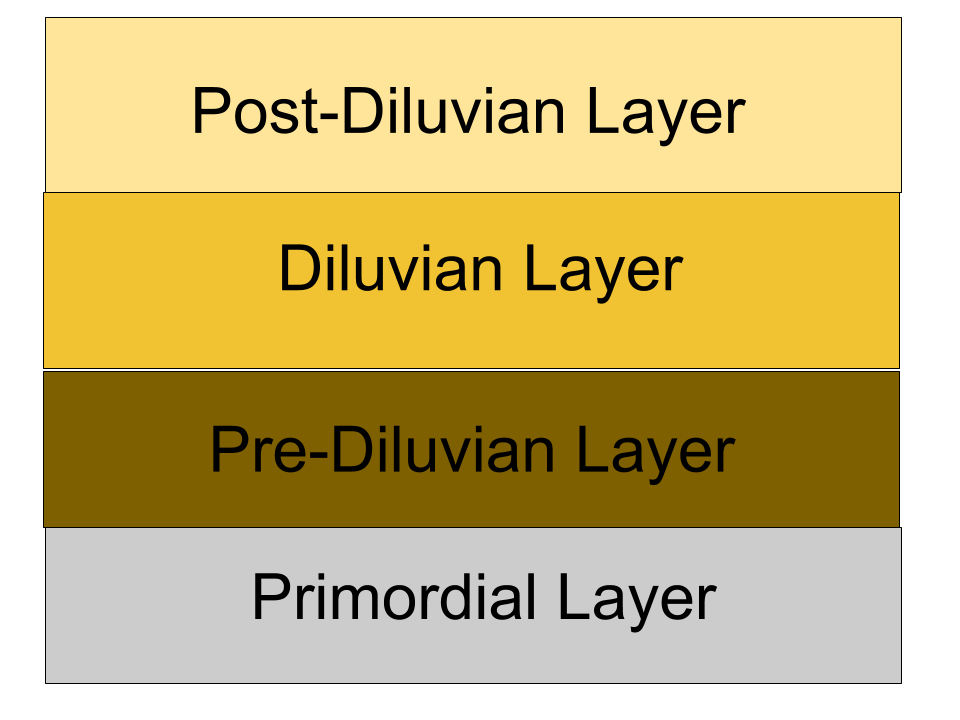
In Part 1 of this blog we found that the creationist geology must have the following structure:

Figure 1 – Creationist Geology with Pre- and Post-Diluvian Layers

The diagram seems to indicate that the Pre-Diluvian, Diluvian, and Post-Diluvian layers are all about the same thickness. But is that what the bible says?

The bible has its own internal chronology, which I have documented in this blog entry: https://david-seldon-moore.blog/2019-09-14-biblical-chronology-part-2

Based on that chronology we can assign some well known dates to some of the boundaries of the diagram, as shown below:

Creationist geology with some well known dates

The only boundary to which we cannot immediately assign a date is that between the Pre-Diluvian and the Diluvian layers. To know how thick the Pre-Diluvian layer must be we would have to know how long it takes sedimentary rock to solidify, according to the bible.

We can answer that question by considering this passage:

The sons of Ham: Cush, Egypt, Put, and Canaan.

Genesis 10:6, Revised Standard Version

Ham was one of the sons of Noah. So this passage means that according to the bible the nation of Egypt didn’t exist until after the flood.

Mainstream archaeology says that the unification of Upper and Lower Egypt happened sometime between 3100 and 3000 BCE. That’s at least 500 years before the time of the flood.

Of course creationists don’t accept any of the claims of modern archaeology– they regard the findings of archaeology as every bit as suspect as those of modern physics. So let us now investigate the Step Pyramid, constructed by the Pharaoh Djoser. According to mainstream archaeology this building was constructed at around 2650 BCE, though of course creationists do not accept that date as it predates the flood, according to the biblical timeline.

Let us for the moment entertain the possibility that both Egypt and this building were created after the flood and see if that leads to any complications.

The key fact about the Step Pyramid that makes it so important to this discussion is that it is made of stone. That means that by the time this building was built the sedimentary materials deposited by the flood must have solidified to become rock.

So according to the bible Ham, the son of Noah, had a son Egypt, who would have had to travel from the mountains of Ararat (probably in modern Turkey) to the Nile river valley. Then his descendants would have had to populate the valley and effect the unification of Upper and Lower Egypt, and after a period of time that was at least 350 years, according to mainstream archaeology, the Step Pyramid would have been built. Here’s the sequence:

  • Ham’s son Egypt is born
  • Egypt and his family migrate to the Nile river valley
  • The entire Nile valley is populated with about 100,000 people
  • Upper and Lower Egypt are unified to form the nation of Egypt
  • Pharaohs of the Old Kingdom make Egypt the greatest nation on earth over a period of at least 350 years
  • Pharaoh Djoser commissions the construction of the Step Pyramid, using stones quarried nearby

We can’t provide an estimate for the times of the first two events in the above list. There is nothing in the bible that specifically dates either of these events. The third event– the population of the Nile river valley– would have taken about 500 years. And according to mainstream archaeology the sixth event would have happened about 350 years after the second.

What we need is some way to correlate the above sequence of events to the timeline of the bible. Conveniently there is this passage in the bible:

In the fifth year of King Rehoboam Shishak king of Egypt came up against Jerusalem; he took away the treasures of the house of the LORD and the treasures of the king’s house; he took away everything.

I Kings 14:25, Revised Standard Version

The date of this invasion is established by external sources as 925 BCE. So now we have the following approximate chronology for the events leading up to the invasion of the Levant:

  • The flood ends in 2460 BCE
  • Ham’s son Egypt is born
  • Egypt and his family migrate to the Nile river valley
  • The entire Nile valley is populated with about 100,000 people over a 500 year period
  • Upper and Lower Egypt are unified to form the nation of Egypt
  • Pharaohs of the Old Kingdom make Egypt the greatest nation on earth over a period of at least 350 years
  • Pharaoh Djoser commissions the construction of the Step Pyramid, using stones quarried nearby
  • A great many pharaohs rule Egypt over a period of 1725 years
  • The pharaoh Shishak / Shishonq I invades the Levant in 925 BCE

So there is a total of 1535 years between the end of the flood and the invasion of the Levant in 925 BCE. But the events listed above would have taken a minimum of 2575 years, according to mainstream archaeology. The only way that Creationists can make this work is by scrunching 2575 years of events into a 1530 year period. Doing so will of necessity move the time of the construction of the Step Pyramid closer to the time of the unification of Upper and Lower Egypt. Mainstream archaeology says that took about 350 years. Let’s say that Creationists scrunch it down to 250 years. Well, that gives us the date we need. 500 years to get Egypt son of Ham from the mountains of Ararat to the Nile river valley and to populate it with about 100,000 people; and 250 years to prepare the way for the construction of the Step Pyramid. That’s a total of about 750 years– the minimum time it would take for sedimentary material to solidify and become rock, according to the bible. And now we can redraw the diagram to show the relative sizes of the layers of rock:

Completed Creationist Geology

The diagram is not to scale, but here are the relative sizes of the 3 non-primordial layers:

  • Pre-Diluvian Layer: 907 years; about 14.7% of the total
  • Diluvian Layer: 750 years; about 12.2% of the total
  • Post-Diluvian Layer: 4479 years; about 72.9% of the total

The upshot of this discussion is that the Diluvian layer is the only layer that could possibly be hydrologically sorted; yet it accounts for no more than 12.2% of the total fossil record. All of the rest of the fossil record– by far the majority– should be chronologically sorted. So hydrological sorting cannot possibly account for the sequencing of the fossils in the geological record, and creationist geology doesn’t even accord with the creationist interpretation of the biblical narrative.

Written 2019-06-10.

Copyright (c) 2019 David S. Moore. All rights reserved.

Creationist Geology, part 1


Young earth creationists claim that the entire universe was created in six days, and that those days were not “days in the eyes of God” but actual real 24 hour periods of time.

Modern geology says that the oldest rocks of earth are about 4.2 billion years of age, that the oldest rocks of our solar system are about 4.5 billion years of age, and that life has existed on this planet for at least 3.5 billion years.

Young earth creationists say that’s completely wrong.

So what do young earth creationists have to say about geology? How do they counter the vast wealth of geological knowledge that has been accumulated since the time in 1799 when William Smith produced the world’s first map of geological outcrops?

Chiefly, they deny that the many measurements of the ages of the rocks of earth are accurate. This propaganda campaign has lost every assault that creationists have brought against modern geology in courts of law across this land. But that has done little to dissuade the advocates of young earth creationism from continuing to claim that modern geology is somehow flawed, or biased, or based on unsound principles.

To amend for the deficiencies of mainstream geology young earth creationists have invented their own fantasy geology. It looks like this:

This image has an empty alt attribute; its file name is creationist-geology-1.png
Figure 1: Young Earth Creationist geology

This geology consists of two significant layers:

  • The Primordial layer, which was created by God at the time of the creation
  • The Diluvian layer, which contains the entire fossil record and was created by the flood

The rocks of the Primordial layer are presumed to be as old as the universe. In the young earth creationist view that would make the rocks of this layer about 6100 years old.

As mentioned above modern geology pegs the oldest rocks of earth at about 4.2 billion years old. That is about 70 MILLION percent longer than the 6100 years that creationists claim the universe is old. That’s an enormous percent of error.

Bear in mind that modern science is generally not satisfied with anything less than 5 sigma accuracy. That represents an accuracy of 99.97%. That level of accuracy is routinely obtained in physics. Science is the process by which humanity has learned how to build the products of modern technology– automobiles, refrigerators, computers, cell phones… The types of consumer products that all citizens of the modern world, including creationists, use and enjoy every day. And yet creationists expect us to believe that physics– which developed the tools for measuring the ages of rocks– is off by 70 MILLION percent.

The rocks of the Diluvian layer were supposedly created when the waters of the flood receded. According to this line of thinking, the waters of the flood rushed across the face of the earth and ripped up all loose dirt, clay, mud, gravel, sand, and topsoil. These materials were then dissolved in the water and held in suspension in a six mile deep stew. Then when the waters of the flood settled down the materials held in suspension settled out into nice neat layers. And when the waters of the flood finally receded those neat layers were perfectly preserved, as is seen in such layered cake formations as the Grand Canyon.

A key component of this fantasy geology concerns the ordering of the fossils in the fossil record. Everyone, even creationists, agree that the fossil record is highly ordered. Mainstream geology asserts that the layers of the fossil record were deposited chronologically, with the oldest layers at the bottom and the layers getting progressively younger as you ascend the geological column.

But creationists argue that because the entire fossil record was laid down all at once by the draining of the waters of the flood the fossils in the fossil record aren’t ordered chronologically. Instead, creationists claim, the fossils were sorted by the waters of the flood. So the ordering of fossils in the fossil record is based on the hydrological properties of the bodies of the animals and plants killed by the waters of the flood. This is what creationists call hydrological sorting.

There is no proof that this notion of hydrological sorting could explain the observed ordering of fossils. Consider bivalves. Fossils of these animals can be found throughout the fossil record. Bivalves can be found in the Ordovician strata, which mainstream geology dates to 488 to 443 million years ago; and many bivalves from that era closely resemble modern bivalves. So their hydrological properties should be strongly similar. Why would one group of bivalve fossils be found at a lower level than another if hydrological sorting were the only physical principle in operation?

Creationism isn’t a science, and although there are a million scientific objections to the creationist fantasy geology, none of them would have much impact on the thinking of a creationist who can find reason to believe that modern science is off by 70 MILLION percent. So rather than attempt to provide the scientific evidence that creationists will never accept anyway I will show that creationist geology doesn’t even comport with their own narrative.

According to the bible there were people and animals and plants that lived and died prior to the flood. Question: what would have happened to their bodies? Answer: Over time their bodies would have been covered with sediment. That sediment would have gotten compacted and compressed and would have turned to rock. And the bodies entombed therein would have been converted to fossils. That means there should be another layer of fossils below the diluvian layer that contains the fossils of the people and animals and plants that lived and died before the flood, as shown in the following diagram.

This image has an empty alt attribute; its file name is creationist-geology-2.png
Figure 2: Creationist Geology with Pre-Diluvian Layer

Most importantly, the fossils of this layer would have been laid down chronologically and would therefore not be hydrologically sorted. That means that the boundary between the Pre-Diluvian layer and the Diluvian should be unmistakable and very easy to identify.

Furthermore, according to the bible there were people and animals and plants that lived and died after the flood. Question: What would have happened to their bodies? Answer: Over time their bodies would have been covered by sediment. That sediment would have gotten compacted and compressed and would have been turned into rock. And the bodies entombed therein would have been converted to fossils. That means there should be another layer of fossils above the Diluvian layer that contains the fossils of the people and animals and plants that lived and died after the flood, as shown in the following diagram.

This image has an empty alt attribute; its file name is creationist-geology-3.png
Figure 3 – Creationist Geology with Pre- and Post-Diluvian Layers

This layer too would have been deposited chronologically, and therefore the boundary between this layer and that of the Diluvian layer should be clear and easy to identify.

So has this pattern ever been observed at any location anywhere in the world? No, decidedly not. And people have looked. Here are 25 locations where geologists have observed all 12 of the periods of the Phanerozoic in order:

  • The Ghadames Basin in Libya
  • The Beni Mellal Basin in Morrocco
  • The Tunisian Basin in Tunisia
  • The Oman Interior Basin in Oman
  • The Western Desert Basin in Egypt
  • The Adana Basin in Turkey
  • The Iskenderun Basin in Turkey
  • The Moesian Platform in Bulgaria
  • The Carpathian Basin in Poland
  • The Baltic Basin in the USSR
  • The Yeniseiy-Khatanga Basin in the USSR
  • The Farah Basin in Afghanistan
  • The Helmand Basin in Afghanistan
  • The Yazd-Kerman-Tabas Basin in Iran
  • The Manhai-Subei Basin in China
  • The Jiuxi Basin China
  • The Tung t’in – Yuan Shui Basin China
  • The Tarim Basin China
  • The Szechwan Basin China
  • The Yukon-Porcupine Province Alaska
  • The Williston Basin in North Dakota
  • The Tampico Embayment Mexico
  • The Bogata Basin Colombia
  • The Bonaparte Basin, Australia
  • The Beaufort Sea Basin/McKenzie River Delta

(For more details see: http://www.talkorigins.org/faqs/geocolumn/)

In none of the above formations has the creationist pattern ever been observed. But if creationists are correct their pattern should be observable in every geological formation around the globe.

In creating the previous diagram I have cheated somewhat. I’ve made it appear that the three layers– the Pre-Diluvian, Diluvian, and Post-Diluvian– are all of about the same thickness. But is that what the bible tells us? We will explore this question further in Part 2 of this blog.


Written 2019-06-09.

Copyright (c) 2019 David S. Moore. All rights reserved.

Religion in the U.S. Constitution

Congress shall make no law respecting an establishment of religion, or prohibiting the free exercise thereof…

Amendment 1 to the Constitution of the United States

The First Amendment of the Constitution makes it clear that the United States is never to become a theocracy. The authors of the Constitution were mindful of the hazards posed by state religions of any kind, and they wanted to prevent the United States from suffering their worst effects.

Does the First Amendment protect religious beliefs, or does it protect religious practices? The wording of the Amendment seems to imply that it protects both. The phrase “the free exercise thereof” seems to encompass not just religious beliefs, but religious practices as well.

But that isn’t a plausible interpretation. Consider the following scenario. A judge, who is an ardent and practicing Catholic, is presented with a case involving a Catholic priest who is charged with pederasty. His attorney is a Jesuit who argues that the court has no jurisdiction in the case because the Vatican claims priority involving all Catholic clergy. Because the judge regards himself as a staunch Catholic, he agrees and releases the defendant to the custody of the Vatican.

Article VI of the Constitution says the following:

The Constitution, and the Laws of the United States which shall be made in Pursuance thereof; and all Treaties made, or which shall be made, under the Authority of the United States, shall be the Supreme Law of the Land; and the Judges in every State shall be bound thereby, any Thing in the Constitution or Laws of any State to the Contrary notwithstanding.

Article VI of the Constitution of the United States

So the judge described in the scenario above would be bound to regard the Constitution as the supreme law of the United States, regardless of whatever claims the Pope might make to the contrary. And the decision to turn the defendant over to the Vatican would be an act that violates the Constitution, regardless of the wording of the First Amendment.

Consider now the case of a judge who, when he is appointed, is an avowed evangelical Christian. And suppose further that after a period of some years he undergoes a spiritual transformation in which he converts to a strident form of Islam that insists on the enforcement of Islamic Law. So when he is brought a case of robbery in which the defendant is found guilty, he sentences the robber to have his right hand and left foot chopped off.

Again, the Islamic judge is bound by his oath of office to follow the Constitution, the laws of the federal government, and the laws of the several states– NOT the teachings of the Koran, or of any other religious writing.

The previous cases involve judges who render opinions in courts of law. What about private citizens? Are their religious practices defended by the First Amendment? Imagine a devout Christian who studies the old testament of the bible and finds to his delight that Jacob had two wives– Leah and Rachel. He also learns that each of these wives had a maidservant, and that Jacob fathered children by both of his wives and by their maidservants– four women in all. Jacob was renamed Israel by God, thereupon identifying him as the patriarch of the Israelites. He thereupon deduces that God must want good Christian men to follow in this practice. So he marries four women in a state that has long since outlawed bigamy.

To consider a more extreme example, suppose that a cult of the Aztec god of war, Huitzilapotchli, takes hold in this country. The Aztecs believed that the god required regular ritual human sacrifices. So the cult leader insists on performing a ritual human sacrifice every new moon in accordance with the ancient practices.

None of these behaviors is protected by the First Amendment. In fact the only religious practices which are protected are those which do not violate the secular laws of the state, and of the nation.

Written 2020-11-25

Copyright (c) 2020 by David S. Moore

All rights reserved

Was The Grand Canyon Created by the Flood?

Some Creationists claim that the Grand Canyon was created by the biblical flood. Is that true?

The waters of the flood

Before we can figure out what the waters of the flood may have sculpted we should first try to understand where the waters came from. The story of the flood (as reported in the bible) says the following:

In the six hundredth year of Noah’s life, in the second month, on the seventeenth day of the month, on that day all the fountains of the great deep burst forth, and the windows of the heavens were opened. And rain fell upon the earth forty days and forty nights.

Genesis 7:11-12, RSV

So we now know that some portion of the waters that covered the earth came from the skies in the form of rain, and the rest burbled up from the depths. The bible gives us a very specific measure of the total amount of water that covered the earth:

And the waters prevailed so mightily upon the earth that all the high mountains under the whole heaven were covered; the waters prevailed above the mountains, covering them fifteen cubits deep.

Genesis 7:19-20, RSV

That works out to a depth of about 6 miles across the entire planet. Let’s suppose that the waters which poured down from the skies came directly from the atmosphere, and that those waters were returned to the atmosphere when the flood waters receded.

Question: If we were to extract all of the water vapor currently held in suspension in the atmosphere and dump it all over the surface of the earth, how deep would the resulting ocean be?

Answer: About 1.5 inches. That’s a far cry from 6 miles. (https://www.livescience.com/how-much-water-earth-atmosphere)

The atmosphere just doesn’t have the capacity to store even one tenth of the six mile depth of water that covered the planet. The only way to increase the atmosphere’s holding capacity would be to greatly increase the temperature of the atmosphere– to several hundred degrees. Furthermore, that much water in the atmosphere would massively increase its density– to about the same pressure that would be found at the bottom of a 3 mile deep ocean. That’s about three tons per square inch! That’s simply not survivable.

At this point we don’t even know where the water that rained down on the planet for 40 days and 40 nights came from. So let’s assume that half of the 6 mile depth of water was due to the rains that fell from the sky, acknowledging that we still don’t know how the atmosphere could have held that much water, and that the rest of the water surged up from below the surface of the earth. We will further assume that the water that fell from the skies was returned to the atmosphere (by an unknown mechanism), and that the water that burbled up from the depths returned to the depths. And we shall conjecture that the waters that returned to the depths carved the Grand Canyon as they receded.

The fossil record

Creationists claim that the entire fossil record was created by the flood. They say that the waters of the flood rushed across the face of the earth and dissolved all of the loose dirt, clay, mud, gravel, and topsoil, along with the bodies of all of the people, animals, and plants that were killed by the flood. Then as the waters calmed, the materials held in suspension settled into neat layers arranged by “hydrological sorting,” a fancy phrase meaning “in order of natural buoyancy.” When the waters receded those nice neat layers were perfectly preserved, as seen in the walls of the Grand Canyon, and in many other such geological formations around the world.

The above narrative means that at the time the waters of the flood receded, the entire surface of the earth would have been covered in a thick layer of mud. As water rushed across the mud on its way to disappear into the depths, it wouldn’t have carved nice neat walls in the mud. When massive torrents of water rush across a landscape of mud, the mud just collapses. So the result would not have been the carving of a canyon with crisply defined walls– it would have been a massive undifferentiated pile of mud. And after the water had receded the mud would have leveled out to form a plain– which is literally the opposite of a canyon.

Another question: Why did the mud of Arizona get carved into a canyon, rather than, say, the mud of central Texas? Texas is pretty flat, and there aren’t many examples of canyons across vast stretches of the Lone Star State. But if the creationist narrative about the creation of the fossil record is true, then at the time that the waters of the flood receded, the mud of Texas should much the same composition of the mud of Arizona. There shouldn’t be any reason why a canyon would have been carved in Arizona but not in Texas.

Unless, of course, there was a drain somewhere in northern Arizona and the waters of the flood rushed toward that on their way back down to the depths. But when water rushes down a drain it creates an eddy– a whirlpool– and the Grand Canyon definitely does not look as though it was carved by a whirlpool.

A true flood geology

The simple fact is that the Grand Canyon isn’t a flood geology– it’s a river erosion geology. For an example of a true flood geology the place to look would be Eastern Washington State in a region known as the Channeled Scablands. As settlers traveled through this region they saw that the land consisted chiefly of exposed bedrock with little or no soil. They called the region a “scabland” because it was land that was unsuitable for farming.

The Channeled Scablands were formed by dozens, perhaps hundreds of floods that happened at the end of the last ice age, between 15,000 and 14,000 years ago. The waters of a glacial lake named Lake Missoula were held back by an ice dam that repeatedly broke over a course of many hundreds of years, releasing more water than is contained in Lake Ontario and Lake Erie combined. Those waters rushed across Northern Idaho and Eastern Washington, scouring the surface down to bedrock and pushing the accumulated soil, gravel, clay, and rocks to the south and west. These floods are known collectively as the “Lake Missoula Floods.” Some of these floods resulted in volumes of water that would have been ten times greater than the sum of all of the rivers of the world combined.

The region of the Channeled Scablands, which is 9 times the area of the Grand Canyon, is populated with a number of geological features that are characteristic of flood geologies, none of which are to be found in the Grand Canyon.

Coulees

The Channeled Scablands has more than 140 geological formations known as coulees. These are large gullies that were carved by water– in a region where there is presently no source of water. The Grand Coulee is more than 60 miles long. These very distinctive formations can be seen throughout the region. There is not a single coulee to be found in the Grand Canyon– because the Grand Canyon does have an obvious source of water: the Colorado River.

Kolkes

A kolke is a giant conical divot that has been carved by water out of bedrock. There are hundreds of kolkes across Eastern Washington. The colloquial term for them is “potholes.” Washington State even has a state park named “The Potholes State Park.” Kolkes were formed when water several hundred feet deep rushed across the land at 45 to 60 miles miles per hour. The rushing water created whirlpools that drilled into the bedrock, creating conical divots that later filled with rainwater to create small, isolated lakes.

Ripples

When water rushes across a landscape it can form ripples in the land. Beachcombers are familiar with this phenomenon– as can be seen in the following photo:

Ripples in beach sand

But the ripples of the Channeled Scablands are immense– some 30 to 40 feet high and 100 feet apart. Here’s a photo (taken from Google Maps):

Ripples of this type can be found throughout the Scablands, proving once again that rushing water was the mechanism that formed them.

Erratics

As the waters of the Lake Missoula floods raced across the landscape they scooped up dirt, clay, mud, gravel, topsoil– and boulders. All of this material was deposited downstream in huge piles, and many of the boulders were simply dropped at points along the way. Such boulders are called “erratics” because they originated far from where they were found. Erratics can be found throughout the region. Some erratics may have been carried on or within icebergs that flowed downstream with the rushing waters.

Flood Bars

The waters of the Missoula Floods pushed huge amounts of soil, rock, and other material south and west. Some of this material was pushed as far south as the Willamette Valley in Oregon. Regions where the material was dumped by the floodwaters are known as “flood bars,” and they can be found throughout the region.

Further information

The Missoula Floods have been thoroughly studied and documented, and research on the geological history of this region continues. The Ice Age Floods Institute’s web site at https://iafi.org/ is an excellent resource for further background information. The Institute’s web site includes links to many other sources of information about the ice age floods. Be sure to view the interactive map, as it is annotated with dozens of detailed notes about the Missoula Floods.

Conclusion

The story of the flood in the bible is a ridiculous story. It would have been impossible for the atmosphere to hold any significant percentage of the six mile depth of water that supposedly covered the earth– unless the temperature of the atmosphere were raised to several hundred degrees. I seriously doubt that even the most strident of creationists would expect us to believe that.

The mechanism that creationists would have us believe by which the floodwaters carved out the Grand Canyon is every bit as ridiculous. It doesn’t account for the fact there would have been nothing to distinguish the geology of northern Arizona at the time from that of Dallas. Why didn’t the waters of the flood carve a grand canyon near Dallas? Because the flood story in the bible is a fairy tale, not an historical narrative.

The Grand Canyon is a river erosion geology, not a flood geology. The Channeled Scablands of Washington State are the best example of a true flood geology to be found anywhere in the world– but floods of this dimension undoubtedly happened elsewhere at the end of the last ice age. As the ice age glaciers melted it would have been natural for lakes to form at the southern boundaries of the glaciers. It would certainly have been possible for ice dams that held back the waters of such lakes to collapse, just as did the dam of Lake Missoula. And that could mean that there are other as of yet unrecognized flood geologies that have a history similar to that of the Channeled Scablands just waiting to be discovered.

Copyright (c) 2022 by David S. Moore

All rights reserved