The Flat Earth model, part 4: Movement

Does the earth move? That simple question has been the subject of more than 2,000 years of philosophical, theological, and scientific dispute. The Ptolemaic theory of planetary movement asserted that the earth is fixed and immovable at the center of the universe, as the bible says:

Yea, the world is established; it shall never be moved.

Psalm 93:1, Revised Standard Version

Yea, the world is established, it shall never be moved.

Psalm 96:10, RSV

Thou didst set the earth on its foundations, so that it should never be shaken.

Psalm 104:5, RSV

A Greek astronomer by the name of Aristarchus described a heliocentric (sun-centered) model of the universe in the early 200s BCE. He first estimated the size and distance of the moon and then used those results to estimate the size and distance of the sun. His calculations told him that the sun is about seven times larger than the earth. He made these estimates without the benefit of telescopes or spacecraft or even a value of pi. But from his findings he rightly concluded that it would be ridiculous to assume that the sun revolves around the earth since the sun is much larger than the earth.

This is a very interesting conclusion as it implies that Aristarchus was assuming that if one body of mass is orbiting another, then the larger mass must be the one that is stationary and the smaller mass must be the one that is moving. Newton’s universal law of gravitation made that view explicit, but the reasoning of Aristarchus shows that it was implicit even in the earliest thinking about the motion of the planets. Aristarchus might not have been able to express his thoughts about this dynamic in words, but he must have been imagining that the larger body exerts a force on the smaller body. It is the concept of a centrally directed force that was the key to Kepler’s insights about planetary motion, and this concept was clearly nascent in the thinking of Aristarchus.

The radius of the sun is actually about 109 times larger than that of the earth, not seven times. Aristarchus’s calculations were wrong– chiefly because it is very difficult to measure the angle of incidence of light on the surface of the moon with nothing more than the human eye. But Aristarchus was right to conclude that it must be the sun that is stationary, not the earth.

If the earth moves then it should be possible to see nearby stars shift in relative position as compared to more distant stars as the earth moves through its orbit. This phenomenon is known as parallax.

Parallax of the stars was not observed by ancient astronomers. But that’s not surprising, given that the stars are vastly farther away from earth than ancient astronomers imagined. Parallax can in fact be observed with present day ground based telescopes. But no such technology was available to ancient astronomers. As a result the geocentric (earth-centered) model gained broad acceptance.

There were other arguments against the motion of the earth too. If the earth were moving through space wouldn’t we feel a wind? But we don’t feel a wind. Therefore we must not be moving. If the earth were spinning on an axis we would be feeling a constant dizziness. And we don’t feel dizzy. So we must not be moving. All of these various observations led people to believe that the earth is immobile.

The flat earth model has generally been associated with the hypothesis of an immovable earth. One can imagine a flat disk-shaped earth that moves, and one can imagine a spherical earth that is fixed and immobile. So it isn’t necessarily the case that if the earth is flat it must be immobile, or that if it is spherical it must move.

The heliocentric model puts the sun at the center of our solar system, and the earth and all of the other planets in orbit around the sun. That, in fact, is why it is called a “solar” system. Is there any evidence for the heliocentric model?

Absolutely, there is. In fact the motion of the earth has been measured.

In 1838 F.W. Bessel reported that the star 61 Cygni has a parallax of 0.314 arcseconds. That puts the star at a distance of 3.2 parsecs from earth, or roughly 10.4 light years away. So Bessel proved that parallax is real and that it can indeed be used to measure the distances to the stars. If parallax is real, then it must be because the earth moves.

The Hipparcos satellite was launched by the European Space Agency in the 1990s to measure the positions and parallaxes of about 118,000 stars with very high precision. The satellite orbited earth, and so it was able to take advantage of the diameter of the earth’s orbit for its observation of parallax.

In the 1720s James Bradley and Samuel Molyneux made the first successful measurement of stellar aberration, a phenomenon that causes stars to appear to be in a different location to an observer on earth than it would to an observer on the sun. Their efforts resulted in a calculated velocity of the earth as just short of 30 kilometers per second.

The earth does in fact move. We have had proof of that fact for at least 2300 years. The earth revolves around the sun with a period of one year. Because the earth is about 93 million miles from the sun the earth’s orbital velocity is about 66,660 miles per hour, or about 18 miles per second. That equates to about 30 kilometers per second.

But the earth’s movement is more complicated than that. Our solar system revolves around the center of the galaxy. The solar system is about 28,000 light years from the center of the galaxy and it rotates about the galactic center once about every 230 million years. That works out to about 230 kilometers per second, or roughly 7.6 times as fast as the earth is orbiting around the sun.

And in addition our galaxy is moving. The universe is expanding, and our galaxy is moving in the direction of the galaxy Andromeda. Beyond that, our galaxy is one of several in a cluster of galaxies known as the Local Group that is moving collectively in the direction of Virgo at a rate of about 410 kilometers per second. The earth moves, our solar system moves, our galaxy moves, and in fact everything in the universe is moving.

Written 2019-01-27.

Copyright (c) 2019 David S. Moore. All rights reserved.

The Flat Earth Model, part 3: Gravity

The flat earth model is based on a highly fanciful model of gravity. In fact I honestly doubt that any advocate of the flat earth model understands gravity at all. So let’s begin with a simple question: What is gravity?

Isaac Newton conjectured that all bodies of matter in the universe exert an attractive force on all other bodies of matter. He summarized this idea in his universal law of gravitation, which says that the attractive force between two bodies of matter is proportional to the product of their masses divided by the square of the distance that separates their centers of mass:

Figure 1: Newton’s Universal Law of Gravitation

The constant G in the above equation is the constant of proportionality; F is the force; M is the mass of one of the two bodies, m is the mass of the other; and R is the distance that separates them.

This conjecture has two key components. The first is that it applies to all bodies of matter equally– there isn’t one class of bodies that exert a gravitational force and other classes that don’t. This is different from the electric force, for example, in that some types of matter are electrically neutral.

The second key component is that Newton claimed that the gravitational force radiates in all directions uniformly– there isn’t a privileged direction. One often repeated objection to the spherical earth model is that people standing on the “bottom” of the earth would fall off. That’s a perfect example of the failure to understand that Newton’s universal law of gravitation does not identify a privileged direction. In Newton’s universe “down” is the direction that points to the nearest large body of matter. For persons standing on the “bottom” of a spherical earth “down” points toward the center of the earth, just as it does for persons standing on its “top”.

This example illustrates another fundamental principle of our universe, namely its relativity. Every observer’s perception of physical phenomena such as length, mass, time, and down is different from that of any other observer not in the same inertial frame.

But was Newton’s conjecture correct? Is there an attractive force that behaves as he described and can one measure it? In 1797 Henry Cavendish performed the first experiment to observe and measure the force of gravity operating on objects in a laboratory. His experimental design is described in many articles that are available on the Internet.

Cavendish used lead spheres in his testing, but he could just as readily have used spheres of stone, cement, iron, wood– anything. Newton called his law of gravitation universal because he believed it to apply to all material objects, whatever they are made of.

So yes, there is indeed an attractive force between all bodies of matter in the universe, just as Newton had conjectured. But does that force obey an inverse square law as Newton had hypothesized?

This aspect of Newton’s theory of gravitation is due to its second key element, the fact that it is omnidirectional. Think of a body of mass emitting lines of gravitational force. Now surround the body by a concentric sphere. The lines of force intercept the sphere with a density that represents the strength of the gravitational field. Now imagine the sphere increasing in size. As its radius increases its surface area increases in proportion to the square of the radius, and the density of the lines of force intercepting the sphere falls simply because the surface area of the sphere is increasing. The inverse square relationship of Newton’s law is simply a consequence of the fact that the gravitational force radiates in all directions.

In Cavendish’s experiment the attraction between the lead balls was exerted horizontally, not vertically. So we have hard physical evidence that the gravitational force doesn’t only pull vertically.

How would this attractive force work on a disk shaped earth? The standard answer one hears from the advocates of the flat earth model is that it would pull everything “down”. But is that claim really true?

Let’s consider the gravitational force exerted by a disk shaped earth. We’ll construct our disk in such a way that it has the same surface area as our spherical earth, and the same volume. A little mathematics shows that such a disk would have a radius of about 8,000 miles (rather than the spherical earth’s 4,000 miles) and a thickness of about 1500 miles.

Now imagine a building constructed at the very center of a disk shaped earth. For the sake of simplicity we will think of this building as consisting of a stack of stone or concrete blocks.

Figure 2: A disk shaped earth with a building at its center

Now let’s consider the force acting on one cubic inch of the building due to the gravitational force of the earth. The key point we have to consider is the first part of Newton’s universal law of gravitation– namely that all bodies of matter in the universe exert an attractive force. So to account for the gravitational force exerted by a disk shaped earth we have to consider the force exerted by every cubic inch of the earth’s mass, and then we have to sum up all of the resulting forces.

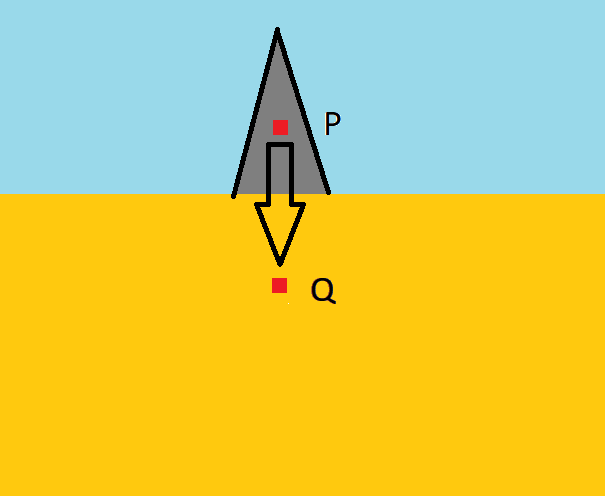
To do that let’s think about a cubic inch of the tower, P, and a cubic inch of the earth directly below it, Q some distance below the surface. The direction of the force exerted by Q pulls directly down, as shown in the diagram below:

Figure 3: The force exerted on a point P of the building by a point Q of the disk shaped earth

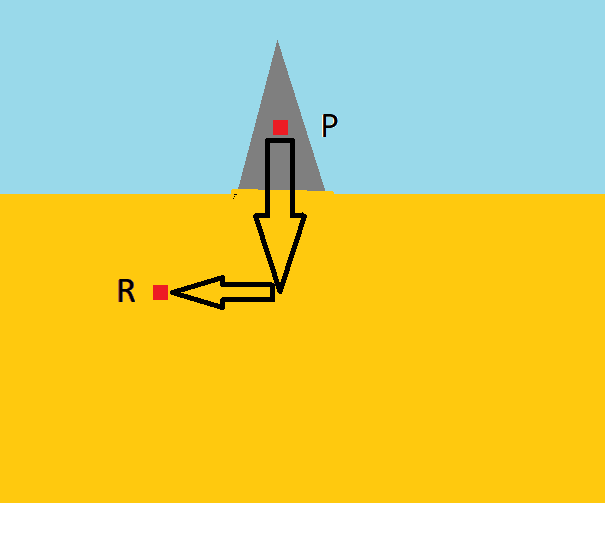
Now let’s consider a cubic inch of earth that is some distance horizontally from the vertical, as shown in the diagram below:

Figure 4: The force exerted by a point R offset from the vertical

The diagram shows that the gravitational attraction between the points P and R can be resolved into two components: a vertical component and a horizontal component.

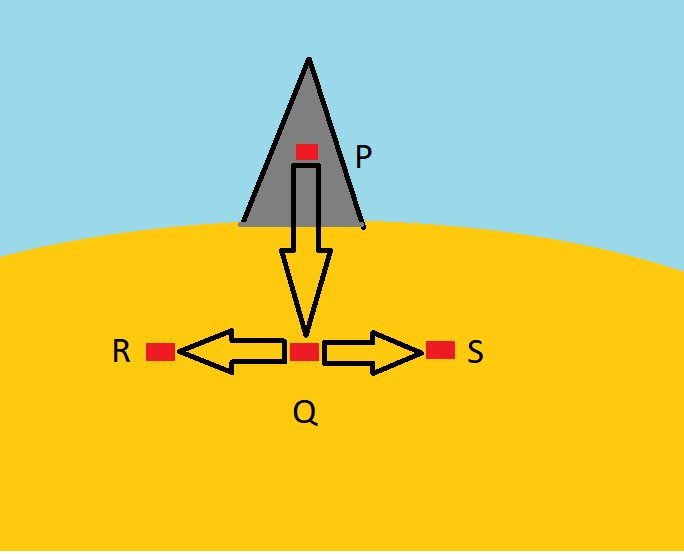
Because a disk is symmetrical around its central axis it is always possible to find another cubic inch of matter in the earth that is at the same depth below the surface, the same distance horizontally from the vertical, and 180 degrees opposite to point R, The diagram below shows the point S that satisfies this condition:

Figure 5: Showing a point S with the same horizontal component as point R

The important fact about point S is that its horizontal component is of the same magnitude as that of point R, but it points in the opposite direction Therefore the horizontal components for points R and S will cancel out with the result that we only have to consider the vertical components. Hence the net force operating on the building will be directed vertically down into the planet, just as we would hope.

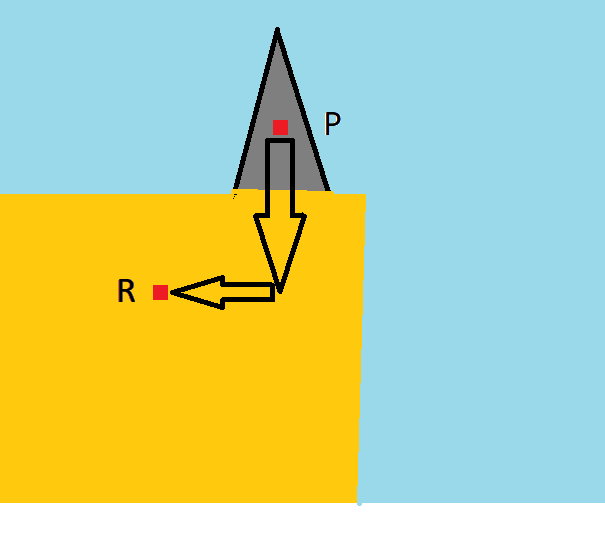
Now let’s consider another building close to the outer edge of the disk, with a point R offset from the vertical, as shown in the picture below:

Figure 6: A building at the edge of the disk shaped earth

As before the diagram shows the gravitational force resolved into a vertical and a horizontal component. But in this case there is no mirror point with which to offset the horizontal force. So the horizontal component of the force exerted by point R would not be offset by that of any other point. And this would be true for every cubic inch of matter of the earth that is horizontally offset from the building.

The net result is that there will be an overwhelming horizontal force that will pull the building horizontally to the left, causing the building to collapse. As a result there would be only one truly safe location on which to build any building on this fantasy earth– at its very center. A building built anywhere else will be ripped down by the planet’s gravitational force.

Incidentally this would give us a very simple way of finding the edge of a disk shaped earth. All one would need is a plumb bob. The outer edge of the disk would be in the direction opposite to that toward which the plumb bob is pulled.

A spherical earth doesn’t have this problem for the simple reason that a sphere doesn’t have an edge. For any location on a spherical earth it is always possible to find a point of matter with which to counterbalance any point that is offset from the vertical, as shown in the diagram below.

Figure 7: A building on a spherical earth

This is not a problem that flat earth propagandists can fix. This problem is the result of the proposed shape of the earth– that is, disk shaped. The only way it can be fixed is by adopting a model that is based on a different shape for the earth– one that has no edge And the only shape that meets that condition is the sphere.

Written 2019-01-26.

Copyright (c) 2019 David S. Moore. All rights reserved.

The Flat Earth model, part 1: A bit of history

The earth is an oblate sphere with a radius of about 4,000 miles. It revolves around the sun in an elliptical orbit at a mean distance of about 93 million miles. And it rotates on an axis that is inclined at about 23 degrees to the plane of its orbit around the sun. I do not take these claims as articles of faith but as observable facts. But I will readily admit that these facts are not trivially obvious, and that their discovery was hard won over a very long time.

The notion that the earth is flat originated in ancient times. More recent propagandists– Samuel Rowbotham and Charles K. Johnson among them– claimed to have proved that the earth is flat. But with the death of Mr. Johnson in 2001 his International Flat Earth Society died along with him and for a time the flat earth model was not widely publicized. But recently there has been a resurgence of interest in the flat earth model. Today there are many web sites that promulgate the flat earth model; here is one:

https://www.tfes.org

Mr. Johnson would not have recognized the model espoused by the contemporary Flat Earth Society. Mr. Johnson was a Christian fundamentalist who believed that the bible states that the earth is flat and unmovable. The link above describes a very different model of the earth– one that is not just moving through space, but that is actually accelerating at the rate of 1 g. And whereas Charles Johnson believed that the sun revolves around the earth the Flat Earth Society’s model shows the sun moving in a circular orbit ABOVE the earth. The Flat Earth Society’s model further asserts that the sun is like a flashlight in that the light it casts on the earth is confined to a narrow cone. I will call the Flat Earth Society’s model the “solar flashlight” model of the flat earth. Charles Johnson’s model, which involves a sun that revolves around the earth, I will call the “traditional” flat earth model.

The arguments one hears from flat earth propagandists betray a wealth of ignorance about the history of this debate. So let’s begin with a brief recounting of the history of the various models of the earth’s shape.

We should mention at the outset that the debate about the shape of the earth has always been entangled with the question of whether the earth moves. That’s because the evidence that the earth is spherical and that the earth moves is not readily apparent. If we look out over a wide expanse do we see a curved horizon or a flat horizon? No, we see only flat horizons, not curved. Residents of our planet do not sense that the earth is moving. If it were moving would we not experience a wind blowing against the direction of the earth’s travels? We experience no such wind. Wouldn’t we get dizzy if the earth were spinning at the rate of 1,000 miles per hour? We experience no such dizziness. These direct observations were sufficient to convince early observers that the earth is flat and that it does not move.

To perceive the curvature of the earth with the naked eye would require vision sensitive enough to detect a difference of 1.6 inches over a length of 100 feet. Human vision just isn’t that sensitive. It’s no wonder that people of the ancient world found it so difficult to believe in a spherical earth.

The model of a flat immobile earth was commonly accepted in the ancient world. We might call it a naive model, but doing so disparages a view that did in fact appear to be supported by physical evidence. I shall call it the “natural” model in recognition of the fact that it is hard to observe evidence of either the curvature or the movement of the earth.

The old and new testaments of the bible include a number of passages that either explicitly or implicitly state that the earth does not move, one of which is the following:

Yea, the world is established; it shall never be moved;

Psalm 93:1, Revised Standard Version

Pope Urban VIII cited a number of such passages as proof that the earth cannot move when he turned Galileo over to the Papal Inquisition for the investigation of heresy.

There are no passages in the bible that explicitly state that the earth is not a sphere, but there are passages that clearly indicate that the authors of the bible believed in a flat earth.

The visions of my head as I lay in bed were these: I saw, and behold, a tree in the midst of the earth; and its height was great. The tree grew and became strong, and its top reached to heaven, and it was visible to the end of the earth.

Daniel 4:10-11, Revised Standard Version

It would not be possible to see a tree, however tall it might be, from all points on a spherical earth, so the above quotation only makes sense in the context of a flat earth model. But although the flat earth model was widely accepted and had the imprimatur of scriptural authority there were clear signs to some thinkers of the ancient world that the earth could not be flat. For example, when a sailing ship heads out to sea the hull disappears below the horizon, then the deck, then the masts. This simple observation could not be explained by a flat earth model.

Eratosthenes of Cyrene was a Greek mathematician who lived from 276 BCE to 194 BCE. He was the first person known to have calculated the circumference of the earth. The experiment he conducted and the method he used were models of elegance. Eratosthenes knew that at noon on the day of the summer solstice the bottom of a well in Syene (near modern day Aswan Egypt) was fully illuminated by the sun. But that was NOT true of wells in Alexandria on the same day. By measuring the deviation of the sun’s rays on the day of the summer solstice from the vertical in Alexandria he was able to calculate the circumference of the earth using nothing more than plane geometry. The value he obtained is in close agreement with modern values. As far as I am aware no advocate of the flat earth model has ever found significant fault in either his reasoning or his method.

Aristarchus of Samos was a Greek astronomer who lived from 310 BCE to 230 BCE. He proposed a heliocentric model of planetary motion in which the earth revolved about the sun on a circular orbit. His ideas were not widely accepted, but at the very least his proposal shows that the geocentric model of planetary motion was not the only model considered by ancient thinkers.

One of the primary objections to the heliocentric model at the time concerned parallax. If the earth is orbiting around the sun, then one should be able to observe nearer stars shifting side-to-side throughout the year relative to more distant stars. This phenomenon was not observed in ancient times. Aristarchus is said to have rebutted this argument with the claim that the stars are so distant from earth that parallax could not be observed. But as this was an explanation of a lack of evidence his heliocentric model lost out to the geocentric model.

Today it is possible to observe parallax with ground based telescopes. Aristarchus was correct, but with the technologies available at the time there was no way for him to prove it. Parallax is another phenomenon that cannot be explained by an immobile earth.

Claudius Ptolemy was an Alexandrian astronomer and mathematician who lived from roughly 100 CE to 170 CE. He was the author of a book known by the title given it by Islamic scholars: the Almagest, or “Great Book”. It was certainly one of the most influential books ever written. It codified a system in which the model of an immovable earth was merged with Greek astrology to explain the movements of the planets. Astrology depended on the precise calculation of where a planet could be seen in the night sky relative to the constellations, whether in the past or in the future. Ptolemy’s system provided a method for making such calculations with great precision.

One of the key difficulties that astronomers sought to explain is that of retrograde motion. Roughly every two years it is possible to observe Mars advancing from west to east in the night sky only to reverse direction later, loop backwards through the sky, then reverse course again to return to its usual west-to-east motion. These observations require patience as the retrograde motion of Mars is only apparent over several weeks.

All of the outer planets exhibit retrograde motion, but that of Mars is the most obvious.

To account for this Ptolemy used what are known as epicycles. The planets, according to Ptolemy, rotated about the earth in circular orbits with circular epicycles. The resulting path would have looked roughly like a spiral looped around a circle.

The system worked in that it could provide accurate calculations for the motions of the planets and therefore accurate horoscopes for those wealthy enough to pay for them.

Ptolemy’s theory– and it was a scientific theory– was enormously successful. It was adopted throughout Rome, the Moslem empire, and Europe. And because it made astrology possible it became indispensable to civilization.

In 1543 Nikolas Copernicus, a Danish astronomer, published a book in the last year of his life in which he advanced a heliocentric model of planetary movement. The earth, Copernicus said, circles the sun, as do all of the other planets.

Copernicus simply did not have enough hard physical evidence to prove his case. But Johannes Kepler learned of the Copernican model and made it his life’s mission to prove that Copernicus was right. For years Kepler labored to develop what we now know as his three laws:

(1) The planets do not move in circular orbits with circular epicycles; rather they move in elliptical paths with no epicycles and the sun is at one of the two focii of each planet’s elliptical path

(2) The line connecting the sun and a planet sweeps out equal areas in equal times

(3) The square of the planet’s orbital period is proportional to the cube of the semi-major axis of a planet’s path

These laws represent the most dramatic shift in thinking about the planets and their orbits since the time of Eratosthenes. They were based on the direct observations of the motions of the planets of Tycho Brahe, which were the most accurate available. And they were verifiable in that one could use his laws to predict the location of any planet in the night sky just as one could with the Ptolemaic theory. The main difference is that Kepler’s theory ascribed a cause for the motions of the planets– the “magnetic” force of the sun.

Kepler’s approach was fundamentally different from that of Ptolemy in that he began from first principles. His objective was to derive the laws of motion of the planets from Brahe’s raw data. To accomplish that he threw out all of the assumptions that were key to both the Ptolemaic and the Copernican theories. Ptolemy was content to define a deferent, an epicycle, an eccentric, and an equant for each planet. Kepler used nothing more than the planet’s distance from the sun and it’s angular momentum.

Isaac Newton developed a theory of what we now call gravitation that was based on an attractive force obeying an inverse square law. It is a standard exercise of mathematical physics to show that Kepler’s laws can be derived from the simple assumption of a centrally directed force that obeys an inverse square law. This confirms that Kepler was right to throw out all of the preconceived notions that were central to the Ptolemaic theory and to attempt to derive the principles of planetary motion from the fewest possible assumptions.

Another standard derivation shows that the possible paths of a satellite under the influence of the gravitational field of a larger mass can only be one of the conic sections: a circle, an ellipse, a parabola, or a hyperbola.

The greatest success of Newton’s theory of gravitation was the discovery of the planet Neptune. In 1781 William Herschel discovered the planet Uranus with the 20 inch reflector telescope he owned. Followers of Newton’s theory were most interested in confirming that the new planet conformed to Kepler’s laws and that its path was indeed an ellipse. But the practiced observers of the time noticed that Uranus’s path had a wobble. Perhaps, it was suggested, there is something amiss in the edifice that Kepler and Newton had erected.

Independently a British mathematician named John Couch Adams and a French mathematician name Jean Joseph Le Verrier conjectured that the path of Uranus was being influenced by another planet in a more remote orbit. And they were both able to calculate an estimated path for it. A German astronomer by the name of Johann Gall saw Le Verrier’s result and used it to discover the planet that we now call Neptune. He found the planet on the first night he looked for it.

The Ptolemaic theory could never have predicted the existence of another planet. It was an ad hoc theory in the respect that deferents, epicycles, eccentrics, and equants were all fitted to the observed motion of each planet, one at a time. Not only was the model developed by Kepler and Newtonian far simpler, it was also far more powerful. Newton’s was a universal theory of gravitation– one that applied to all bodies of matter in the universe. It provided a natural explanation for the cause of each planet’s movement– the gravitational field of the sun. And it was predictive in the respect that it could be used to infer the existence of heavenly objects that had not previously been observed.

The hypothesis of an immobile earth has been exhaustively tested and has failed. The earth does move– it revolves around the sun as do all the other planets– and we now have a profound and powerful explanation for its movement.

What about the shape of the earth? Once it was understood that Newtonian mechanics accurately describes the motions of the planets it was realized that the same principles could be used to launch vehicles into space. Albert Einstein’s General Theory of Relativity adds some additional nuance, but for the most part these differences are not significant to the problem of launching a human occupied vehicle into orbit around the earth.

The launch trajectories of all artificial satellites and manned vehicles that have been vaulted into space have been based on the assumption that the earth is spherical, not disc shaped. A disc of the same surface area as the spherical earth would have twice the radius. If a rocket were launched into orbit around a disc shaped earth on the basis of a spherical earth’s dimensions the rocket would crash before completing even one orbit. When such missions have failed it has not been because of our understanding of the shape of the earth. The spherical earth model has in fact been resoundingly confirmed again and again. All of the photos returned from space vehicles have shown the earth to be spherical, not disc shaped. And these photographs number in the tens of thousands. NASA maintains an archive of photos from the entire history of space missions here:

https://images.nasa.gov/

The story of the debate about the shape of the earth and the motion of the earth is one of the great triumphs of science. Kepler’s laws in particular represent the emergence of a new way of understanding the world around us.

This is not the history of the flat earth debate that flat earth apologists want you to know about. In the following blogs I will discuss at length what they don’t want to talk about, and some of the issues that their completely lame model cannot explain.

Written 2019-01-24.

Copyright (c) 2019 David S. Moore. All rights reserved.

The Flat Earth model, part 2: Daylight


There are many observable facts that advocates of the flat earth model do not accept. Daylight is one of them.

There are two major facts about daylight that any model of the shape of the earth must explain. These are its longitudinal and latitudinal variations.

Anyone who has ever spoken to another person who lives in another time zone is familiar with the longitudinal variation of daylight. At any given point in time one half of the earth is in darkness and one half is in light, and that variation falls along longitudinal lines.

I live in the Pacific time zone; my brother lives in the Eastern time zone. So we are always 3 hours different in time. If I call him at 7 PM my time it’s 10 PM his time. I’m in late evening and he’s in night.

If it is noon in the Pacific time zone at a time of year when no time zone is observing Daylight Savings the time will be:

  • 1 PM in Denver Colorado
  • 2 PM in Chicago
  • 3 PM in New York City
  • 8 PM in London
  • 9 PM in Berlin
  • 11 PM in Moscow Russia
  • 4 AM in Beijing
  • 5 AM in Tokyo
  • 10 AM in Anchorage Alaska

This is not just a human imposed artifice. When it is 11 PM in Moscow it really will be dark outside. When it is 3 PM in New York City it really will be mid-afternoon and therefore daylight outside.

The flat earth model cannot account for this fact. Once the sun appears above the horizon of a flat earth all regions of the planet will experience daylight equally. None will be in darkness.

The spherical earth model accounts for longitudinal variation in daylight quite simply and naturally. From a single point source of light– i.e. the sun– only one half of a sphere can be illuminated at any one time. We have a huge number of confirmations of this phenomenon in the form of photographs that have been taken from artificial satellites and manned space vehicles. For example, this photo was taken by the crew of the Apollo 15 mission:

https://images.nasa.gov/details-as15-91-12343.html

The photo shows Africa and Europe in shadow while South America is in daylight. Here’s another that was taken on the Apollo 13 mission that shows a portion of North America in daylight:

https://images.nasa.gov/details-as13-60-8588.html

And here’s one that shows the earth as a crescent:

https://images.nasa.gov/details-as4-01-750.html

None of these photographs would be possible if the earth were shaped like a disc.

These variations in daylight are longitudinal in that they fall along the lines of the earth’s meridians– that is, lines of longitude. Latitudinal variations are those that have to do with the distance a location on the earth’s surface is from the equator. Regions that are closer to the North and South poles experience far more hours of daylight during their summer months than do equatorial regions, and far fewer hours of daylight during their winter months. I live close to the 47th parallel. At the summer solstice we receive about 16 hours of sunlight in the day, and at the winter solstice we receive about 8.5 hours. A person living on the equator would receive 12 hours of sunlight every day of the year. Here is a short video that shows what it is like to live north of the Arctic Circle in the summer:

Furthermore the northern regions experience summer when the southern regions are in winter. In winter the sun never rises above the horizon on at least one day per year for any location north of the Arctic Circle.

The flat earth model cannot explain this phenomenon. When it is daylight in any one region of the flat earth it would be daylight for all. But that is not true on planet Earth.

The spherical earth model explains this phenomenon quite simply and elegantly. The earth is inclined at an angle of about 23 degrees relative to its plane of rotation about the sun. That inclination means that regions close to the north pole are tilted toward the sun by 23 degrees during the summer months and are tilted away from it by 23 degrees during the winter months. When tilted toward the sun the polar regions will see the sun above the horizon for more hours; when tilted away the sun will appear above the horizon for fewer hours.

This variation in daylight is directly related to latitude, as it is dependent on the distance a region is from the equator. It is the basis of the seasons, something that most people do believe in– maybe even most flat earth propagandists.


Written 2019-01-24.

Copyright (c) 2019 David S. Moore. All rights reserved.

Terraformation

NASA is currently developing plans for sending manned missions to Mars.  There has even been talk of establishing permanent colonies on Mars and even of terraforming the planet.  Imagine a Mars of the future with oceans, lakes, and rivers– teeming with life, and enjoying a temperate climate.  Mars could be the first experiment of the terraformation of planets throughout the galaxy which our species may one day inhabit.

But before we get too ambitious perhaps we should try our hand at terraforming some of the currently uninhabitable lands of our own planet.  About twenty percent of all terrestrial land is desert, most of which is uninhabited. Why don’t we demonstrate our terraforming prowess on a vast terrestrial wasteland such as the Sahara before we attempt to transform another planet?

The Sahara is about 3.6 million square miles, about the same area as the United States.  It has the highest sand dunes in the world– some as much as 590 feet high. The Sahara receives less than 4 inches of rain a year, and a large portion receives less than an inch.

Transforming the Sahara into lush, arable land may seem daunting, but why would anyone think that terraforming Mars will be less difficult?  The Sahara is inhospitable, arid, and hot. Mars is inhospitable, arid, and cold. If we can demonstrate that it is possible to tame the Sahara then there might be reason to believe that we could one day do the same for Mars.

Think of the challenges.  The winds of the Sahara can blow at hurricane force.  When the rains come they are torrential. Dunes drift across the landscape like waves on the surface of the sea.  And there are neither flora nor fauna in vast regions of the deep desert. How can humans improve such an immense wasteland?

The most feasible approach would be to begin at the periphery and transform sand to soil mile by mile.  Water can be extracted from atmospheric humidity. Solar power is available year round. Resources are available and can be exploited, should anyone think it worth doing.  Why do we think it is more noble to terraform Mars than to make the Sahara habitable? Millions of people could benefit today from the transformation of the Sahara. Any benefits the terraformation of Mars might return would only be realized in future generations.

Of course there are national borders to consider.  The bulk of the Sahara exists within the bounds of a number of African nations known for instability and civil war.  Perhaps the venture is just too risky to pursue.

But will it be different on Mars?  Once humans begin to colonize Mars– or any other planet– claims to national sovereignty will be made, borders will be claimed, and battles over those claims will likely be fought.  Anyone who thinks that Mars will provide a clean slate from which to build a pristine paradise simply hasn’t thought deeply about human nature.

There are a great many technologies that can be developed and tested today, here, on planet Earth for the terraformation of inhospitable lands.  We don’t need to travel to another planet to prove them out– we can do that here, now. And millions of people could benefit immediately from such a bold vision today.

Copyright (c) 2020, David S. Moore

All rights reserved

Your mixing you’re semaphores

Most struggling writers need to survive in a corporate world of hard working folks who may have talents in marketing or accounting or engineering or construction or management– but who, as a rule, wouldn’t know a pronoun from a preposition.  When I was working I often found that my inbox was cluttered with poorly written or grammatically meaningless e-mails, like this one:

I spoke to XXXX and is like you to present this document at the YYYY meeting.

Sentences lacking subjects or verbs are shockingly common, as are sentences in which the verb is of the wrong tense, like this one:

They are say the numbers are now at XXXX.

It’s generally not advisable to correct your boss’s grammar.  In fact it’s generally not advisable to correct the grammar of any of your coworkers– unless you don’t mind working with people who wish you would just die in a fiery car crash.  E-mails are often written in haste, so it’s understandable that some grammatical errors could slip by– even with spell-check and grammar highlighting. But when important business documents are written with preposterous word choices I often feel a teacher’s compulsion to make a polite suggestion.  Consider this excerpt, from an HR-written annual review document:

Demonstrates the necessary testing skills and knowledge commiserate with their role and level.

Apparently the author meant to use the word “commensurate,” meaning “in accordance with,” rather than a word which describes a form of empathy.  In my response I struck out “commiserate” and replaced it with “commensurate”, hoping that the author would realize the mistake and that the following year’s form would be corrected.  But when the next review came along, the questionnaire had the same bad wording as before.

Once I reported to the head of the marketing department that a major promotion to be displayed at 20,000 locations was written with the word “your” where it should have had “you’re.”  You just have to wonder if those who are very well paid to produce catchy advertising phrases ever took classes in which they were asked to write sentences commensurate with their roles.

So allow me to commiserate with the many thousands of struggling writers who have had to grit their teeth when reading e-mails or corporate missives that butcher our common tongue.  It’s difficult to be polite in a world in which a command of one’s language is considered an impediment to the duties of commerce. People in the corporate world are busy and are often more concerned with selling than with the proper conjugation of the verbs they employ to that end.  To those who have found themselves in this unwelcome position I would offer the simple observation that you are certainly not alone and that it really is OK– on occasion– to correct the grammar of those corporate documents that threaten to blemish your company’s public image.

American conservatives are communists

After many decades of observing and participating in American politics I have concluded that American Conservatism is a form of Communism.  There simply is no other explanation for the behavior of American Conservatives over the last 30 years. Don’t listen to their beguiling words about limited government and personal responsibility– look at what they do.  The first impulse of conservatives, whenever they have gained power, has been to cut taxes. The advocates of this policy have long claimed that tax cuts solve every ill. They stimulate economic growth; they reduce the growth of government; and they return riches wrongly stolen from deserving citizens.  Ronald Reagan cut taxes; George W. Bush cut taxes; and Donald J. Trump has recently enacted a tax cut. The only conservative president of the last 30 years who did not cut taxes was George H.W. Bush, and he was excoriated by the leaders of his party for that failure of principle.

Each of those tax cuts was specifically tailored to benefit the super super super rich.  The argument in favor of this economic policy is that those with money to burn will invest it in high risk ventures that create innovation and, consequently , jobs.

The most dramatic change in the American economy over the last 30 years has been a massive concentration of income and wealth.  The super super super rich have become ever more rich, while the wages of the average American worker have stagnated. The portion of personal income going to the top one percent has increased from 8.9 percent in 1980 to more than 22 percent today.  And only the top two quintiles of families have seen their net worth increase between 2000 and 2011. Families in each of the lower three quintiles have actually seen their net worth decline over the same period. See inequality.org for more details.

Conservatives must certainly be aware of this massive shift of economic power.  As they have reminded us at every opportunity, conservatives have a deep and abiding understanding of economics, whereas liberals only know how to waste government funds.  Certainly they must view this most dramatic shift of the economy as a consequence of their own strivings and machinations.

Conservatives must also know of the revolutions of France, of Russia, and of China.  They must be enough aware of historical trends to know that as wealth is concentrated in the hands of an ever diminishing minority of ultra ultra ultra rich plutocrats the masses will turn to the only option available for the redress of their disenfranchisement– revolution.

Conservatives have been advocating tax cuts that have chiefly benefited the rich for the past 30 years.  Each time they achieved their goal of passing tax cuts they have claimed victory. They have repeatedly taken credit for the one governmental policy that has most influenced the structure of the American economy.  Hence they must approve of the long term impact of this their most favored policy. The only logical conclusion is that conservatives are planning for the long term. They must be arguing for tax cuts because they intend to skew the economy to such an extreme that the masses are forced to rise up in revolt.  In short, they must be planning for a communist revolution. American conservatives must be communists.

Copyright (c) 2020, David S. Moore

All rights reserved

U.S. Government is NOT democratic

“We the People of the United States, in Order to form a more perfect Union…”  Famous and stirring words.  But words that leave unanswered an important question: Union of what?

The structure of the sentence is such that you would think that it is the people who are intended to be the chief beneficiaries of that more perfect union.  But a careful reading of the document shows that it was really intended to form a union of states.

Article I of the Constitution vests the legislative powers of the government in two bodies– the House of Representatives and the Senate.  Senators are apportioned two per state, so they clearly represent states, not the people. (Originally Senators were elected by state legislatures, but the 17th Amendment replaced that method with direct election by the people of each state.)

Members of the House of Representatives are elected directly by the people of each state, so it would seem to be the more democratic of the two institutions.  But there are two additional conditions that skew the House toward small states.  The first is the requirement, stated in Article I, that each state must have at least one representative.  The second concerns The Permanent Apportionment Act of 1929, which fixed the size of the House at 435 members.  Thanks to these two rules the House of Representatives provides smaller states with disproportionate representation.  California has a population that is almost 80 times larger than that of the smallest state, Wyoming, but it only has 53 representatives in the House.  So a voter in Wyoming has greater representation in both the House and the Senate than does a voter in California.

The Permanent Apportionment Act of 1929 was intended to keep the House of Representatives fixed at a “reasonable” size. It was felt that if the numbers of representatives were to increase as the population increased it would eventually result in a body too large to achieve any meaningful result.

Our Constitution was chiefly intended to protect the rights and powers of the states, not the people.  (The Bill of Rights was added after the Constitution was ratified to protect the rights of citizens.)  Because the makeup of the U.S. legislature favors small states over large states it does not represent the citizens of the United States in proportion to their numbers and therefore our government cannot be called a democracy– or even a representative democracy.

Should we regard this as a problem? Or should we just shrug our shoulders and surrender to the weight of history and accept the current order as sufficient for the purposes of government?

The chief problem with the current order is that the people of this country are not getting what they want from their government. Large majorities of the American people favor more gun controls, not less. Large majorities want abortion to be legal, and they want it to be available to those least able to pay for it. Large majorities want more to be done about climate change and about our crumbling civil engineering infrastructure.

But measures to make progress on these issues have repeatedly stalled in the U.S. Senate. And why? Because the people of states with smaller populations often perceive such issues as being inimical to their local culture. There are 9 states that have more than half of total U.S. population. That gives those states only 18 percent representation in the U.S. Senate. That’s just wrong– and it has resulted in a stagnant government that is stuck in the past.

There is only one way that this stranglehold can be broken. And that is by breaking the association between states and the way that senators and representatives are elected. As currently configured the federal government only has one elected person who represents the nation as a whole– and that is the President. All other elected officials represent localities. As a result the President alone represents the will of the people of the nation; all others represent the will of states, or of regions within the states.

I fully accept the principle that if either the Senate or the House were to grow without bound as the population increases they will reach a point where it will be impossible for the two bodies working jointly to govern. That is, there must be an upper bound on the sizes of each of the two bodies. These maximal sizes should be governed by the psychology of group dynamics, rather than by the numbers or geographical dimensions of the several states.

I propose a bicameral system of legislature with a Senate and a House, as we have today– but with the pronounced difference that the Senate would represent the people of the nation as a whole, while the House would represent local regions within the nation. States would continue to have the general protections guaranteed under the Constitution, particularly in Article IV. But the people would directly elect their representatives in the federal government irrespective of state boundaries.

Let us say, for point of argument, that we agree on an optimal number of X Senators and of Y Representatives. For the Senate, I propose that the entire voting population of the United States be divided into X units, call them “Senatorial Blocs.” Each voting citizen would be randomly assigned to one such Bloc, and each Bloc would vote to elect one Senator. This approach accomplishes the following objectives:

  • It limits the total number of Senators to X, regardless of the numbers of States in the Union, or the number of people in the voting public
  • It ensures that each Senator is elected by the same number of registered voters
  • It guarantees that the Senators would represent a national perspective, rather than a local perspective

For the House of Representatives I propose that the entire voting population would be divided into Y geographical groupings, call them “Representative Districts.” Each District would represent a geographical region of the country that contains the same number of registered voters– but these regions would be drawn irrespective of state boundaries. The voters of each District would elect one Representative to the House. The Districts should be configured as contiguous, rather than disjoint, to ensure that each District represents a locality with a distinct identity. However this principle will need to be flexible enough to accommodate special cases like Alaska and Hawaii which are not contiguous with any other geographical parts of the United States.

To see how this would work in practice, let’s suppose that the total number of registered voters in the United States is about 200 million, and that we have decided that there should only be 500 members of the House. Then each Representative District should contain a total of 400,000 voters. For some especially dense urban areas several Representative Districts would be packed in close together, while in more rural areas a region might have to span one or more state boundaries to fully encompass its allotment of 400,000 voters. The New York City metropolitan area with its more than 8 million residents might need 40 or more such districts, whereas the voters of the state of Wyoming would probably need to be grouped with those of another bordering state to form one complete district representing 400,000 voters.

This method of electing Representatives would have the following advantages:

  • It would limit the total number of Representatives to Y, regardless of the total number of registered voters or the total number of states
  • It ensures that every voter is represented by exactly one Representative
  • Each Representative would reflect the views of a geographic region of the country with a corresponding regional identity
  • Each Representative would be elected by the same number of registered voters

The conditions set forth above ensure that the two resulting legislative bodies would never grow in size beyond X for the Senate and Y for the House. And they further guarantee that the Senate would represent the perspectives of the nation as a whole, while the House would represent geographical regions with local identities. These two perspectives on the nation’s governance will, I believe, add immeasurable benefits to the long term health of the nation.

But most importantly these policies will change our mode of government to that of a truly representative democracy, since each elected Senator or Representative would be represented by the same number of registered voters as for all other Senators or Representatives, respectively.

Policies such as those outlined above could not have been implemented in 1789, as it would have required a national registry of all voters in the nation. And of course such a registry would have to be updated as voters move from one state to another, or change their names, or die, or become convicted of a crime and therefore lose the right to vote. With the technology available in 1789 it would simply have been impossible to build and properly maintain such a registry. But in today’s world of massively parallel computing systems building a registry of every voter in the country would be a relatively straightforward task. In fact, such a system would solve a number of problems that have been plaguing voting systems throughout the country. How and when to purge voters from the voting rolls? How to prevent voters from voting more than once by registering in two or more states? A national registry of all voters is by far the safest, easiest, and best way to resolve these and other security issues.

The Constitution of the United States is a marvelous construct. It represents a bold and daring break from the monarchical past. It enshrined the principle of the rule of law as an antidote to the arbitrary rule of a king. It has served as an inspiration to other nations that sought a democratic future. And in the principle of self-amendment specified in Article V it showed itself to be adaptable to the challenges and needs of the future.

But the Constitution was a product of its time. It didn’t just allow slavery to persist– it was designed to preserve slavery. It didn’t grant women the right to vote. And it was conceived as a protector of the rights of states. Only after it was ratified were the first ten amendments added as a Bill of Rights, almost as an afterthought, to protect the rights of citizens.

The Constitution followed the general pattern of the Articles of Confederation in that it was designed around States. There is certainly no need or reason to dissolve the States, as they are perfectly viable political entities that are well adapted to serving local needs. But the Legislature of the U.S. Government should represent the needs of the people of the nation as a whole, not the states in particular. And for that reason the current method of electing Senators and Representatives must change.

Written 2020-10-26

Copyright (c) 2020 by David S. Moore

All rights reserved.

The “System” is BROKEN

A recurring slogan one heard from the radicals of the 1960s was that the “system” is broken. Some of them went so far as to claim that the structure of American society is so out of whack that it can’t be repaired– it will have to be burned to the ground and rebuilt.

Although this claim was never articulated clearly enough to know what precisely was meant by the word “system,” there was plenty of evidence that the radicals were right. The Vietnam War dragged on and on because none of our leaders wanted to admit defeat. Minorities were repressed throughout the country and prominent leaders at the national level were working actively to prevent them from being treated as equals. Several cities across America were on fire due to protests over discrimination. Pollution was fouling our air, rivers, and lakes and polluting corporations were doing everything they could to prevent the government from taking action. And the US Congress seemed to be stuck in a pattern of hysteria and inaction.

At the time I reasoned that ours is a democratic government and that as the truth got out to the American people eventually they would demand action. The crushing defeat of George Wallace and his segregationist movement in 1968, the Clean Air Act of 1970, the Clean Water Act of 1970, and the end of the Vietnam War all seemed to confirm my deductions.

But more recently I’ve come to realize that the 60s radicals were right all along. My mistake, I now see, was in believing that our government is a democracy. Yes, Article VI of the Constitution guarantees each state a republican form of government– and yes state Governors and Legislators are elected directly by the people. But at the national level our government is designed chiefly to represent the states, not the people. That’s why it’s called the United STATES of America, not the United People of America. The President is elected by a body that is apportioned by state. The Senate is clearly designed to represent states. And because of rules enshrined in Article I Section 2 of the Constitution and in The Permanent Apportionment Act of 1929 the House Of Representatives is skewed toward protecting the power of small states.

The belief that ours is a democratic form of government is deeply ingrained in American culture. It’s taught in schools, it’s repeated daily throughout all news media outlets, and it’s stated again and again as if it were an obvious truth in every political campaign.  In consequence there is no perception in the general public that anything about our form of government is truly broken. But the 60s radicals were right, even if they couldn’t articulate clearly what was wrong. It’s the Constitution itself that is broken, and our national government has almost no chance of fairly representing the will of the people until these major structural flaws in our government are fixed.

I’d like to believe that we could pass a couple of amendments and thereby put our society on a truly democratic footing. But I know that the residents of small states would never agree to give up their advantage. Perhaps a national campaign to communicate the Constitution’s inherent unfairness could succeed in stirring the people to action, but I see no evidence that any such program could get off the ground. Certainly no one at the national level is arguing that the Constitution is in need of significant revision.

So at present it appears that the most extreme radicals of the 60s– those who argued that the entire system has to be torn down and rebuilt– were right. There is simply no other way for our society to restructure the national government as a representative democracy other than to burn it all down and to hope that whatever emerges in its place will in most respects be an improvement. Large majorities of the American people want more gun control legislation, not less. Sizable majorities want abortion to remain legal. Most Americans want an improved health care system. Most Americans want the government to take the lead on climate change. And yet the US Congress can’t make progress on any of these issues because it doesn’t represent the will of the people.

The obvious problem with that view is that we have ample evidence from history that chaos more often leads to autocracy than to democracy.  The revolutionary fervor that led the French to tear down the Bastille eventually devolved into the autocratic imperialism of the Napoleonic Empire.  The Russian Revolution led to a highly stratified and oppressive nation, not the paradisal society of equals its leaders had foretold.

There are a good many non-governmental issues that have impeded progress as well. First and foremost of these, in my view, is the absolute avalanche of misinformation that pollutes the public discourse. It’s certainly a good thing to have healthy discussions about matters of public policy, but that doesn’t seem to be the least bit feasible at present. Too many of our public leaders have advocated outrageous lies and fantasies. President Trump’s many false statements about COVID19 are but one example. If you don’t even have agreement on a basic set of facts you can’t hope to have a meaningful conversation about something truly complicated like the national economy, or immigration, or climate change.

But I strongly believe that the best and surest way to solve that problem is to change the form of our national government. Why did President Trump repeatedly lie about the lethality of COVID19? He did it to set red states against blue in the expectation that doing so would juice his chances in the Electoral College. The imbalance of our national government distorts all aspects of public discourse and national policy.

If we could tomorrow change our national government to represent the people, rather than the states, it might take 50 or 100 years to know if I am right. I’m pretty sure there is no philosopher or scholar of government who could give us a definitive answer to that question today.  But the fact is that just about every other possible form of government has been tried at one time or another in the past and none has proved to be as capable of providing for the economic, social, and emotional needs of a populace as democracy.

We’ve endured much turmoil during the Trump era, but much worse is yet to come. Climate change will eventually destroy most everything we love about this country. There will be literally millions of climate change refugees vying for water, resources, jobs, and living space– many from Central and South America, but a good many millions from within our own borders as well. Environmental turmoil usually results in political turmoil.  So one very likely result of the disruptions that will inevitably arise from climate change will be the very revolution that the 60s radicals sought to ignite.

Written 2020-11-15

Copyright (c) 2020 by David S. Moore

All rights reserved

Religion in the U.S. Constitution

Congress shall make no law respecting an establishment of religion, or prohibiting the free exercise thereof…

Amendment 1 to the Constitution of the United States

The First Amendment of the Constitution makes it clear that the United States is never to become a theocracy. The authors of the Constitution were mindful of the hazards posed by state religions of any kind, and they wanted to prevent the United States from suffering their worst effects.

Does the First Amendment protect religious beliefs, or does it protect religious practices? The wording of the Amendment seems to imply that it protects both. The phrase “the free exercise thereof” seems to encompass not just religious beliefs, but religious practices as well.

But that isn’t a plausible interpretation. Consider the following scenario. A judge, who is an ardent and practicing Catholic, is presented with a case involving a Catholic priest who is charged with pederasty. His attorney is a Jesuit who argues that the court has no jurisdiction in the case because the Vatican claims priority involving all Catholic clergy. Because the judge regards himself as a staunch Catholic, he agrees and releases the defendant to the custody of the Vatican.

Article VI of the Constitution says the following:

The Constitution, and the Laws of the United States which shall be made in Pursuance thereof; and all Treaties made, or which shall be made, under the Authority of the United States, shall be the Supreme Law of the Land; and the Judges in every State shall be bound thereby, any Thing in the Constitution or Laws of any State to the Contrary notwithstanding.

Article VI of the Constitution of the United States

So the judge described in the scenario above would be bound to regard the Constitution as the supreme law of the United States, regardless of whatever claims the Pope might make to the contrary. And the decision to turn the defendant over to the Vatican would be an act that violates the Constitution, regardless of the wording of the First Amendment.

Consider now the case of a judge who, when he is appointed, is an avowed evangelical Christian. And suppose further that after a period of some years he undergoes a spiritual transformation in which he converts to a strident form of Islam that insists on the enforcement of Islamic Law. So when he is brought a case of robbery in which the defendant is found guilty, he sentences the robber to have his right hand and left foot chopped off.

Again, the Islamic judge is bound by his oath of office to follow the Constitution, the laws of the federal government, and the laws of the several states– NOT the teachings of the Koran, or of any other religious writing.

The previous cases involve judges who render opinions in courts of law. What about private citizens? Are their religious practices defended by the First Amendment? Imagine a devout Christian who studies the old testament of the bible and finds to his delight that Jacob had two wives– Leah and Rachel. He also learns that each of these wives had a maidservant, and that Jacob fathered children by both of his wives and by their maidservants– four women in all. Jacob was renamed Israel by God, thereupon identifying him as the patriarch of the Israelites. He thereupon deduces that God must want good Christian men to follow in this practice. So he marries four women in a state that has long since outlawed bigamy.

To consider a more extreme example, suppose that a cult of the Aztec god of war, Huitzilapotchli, takes hold in this country. The Aztecs believed that the god required regular ritual human sacrifices. So the cult leader insists on performing a ritual human sacrifice every new moon in accordance with the ancient practices.

None of these behaviors is protected by the First Amendment. In fact the only religious practices which are protected are those which do not violate the secular laws of the state, and of the nation.

Written 2020-11-25

Copyright (c) 2020 by David S. Moore

All rights reserved